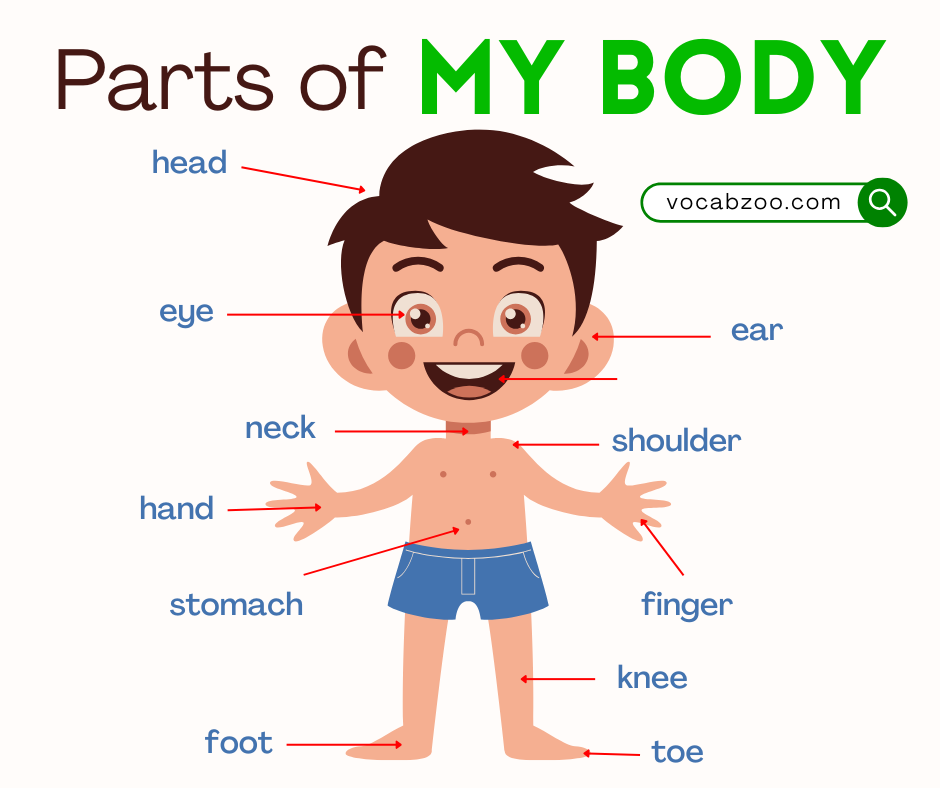
When kids start learning English, it is helpful to know the names of the body parts with pictures. In this blog post, we will explore different parts of the body, like the head, hands, and feet, in a way that makes it easy to remember and say them. Learning body parts helps children speak, read, and write English more confidently while also understanding what others are talking about. Using pictures with words makes learning more visual and enjoyable, so young learners can connect names with what they see every day.
Parts of My Body for kids
Here, we are going to share with you an easy way to remember the names of body parts for kids in English along with their meanings and examples in sentences:
Head and Face
Head
The top part of your body that holds your brain, eyes, nose, mouth.
Example: I hit my head while playing.
Hair
Soft strands growing on top of your head.
Example: She combs her hair every morning.
Eye / Eyes
Organs to see the world around you.
Example: Close your eyes and count to ten.
Ear / Ears
Organs to hear sounds, voices, and music.
Example: I listen to music with my ears.
Nose
Organ for smelling and breathing.
Example: My nose smells flowers in the garden.
Mouth
Used for talking, eating, and smiling.
Example: Open your mouth to eat dinner.
Teeth
Hard parts in your mouth for chewing food.
Example: Brush your teeth every morning and night.
Tongue
Helps taste food, speak, and swallow.
Example: Stick out your tongue for the game.
Cheek
The soft sides of your face below the eyes.
Example: He kissed my cheek gently.
Chin
The bottom part of your face under your mouth.
Example: He rested his chin on the table.
Forehead
The upper part of your face above the eyes.
Example: Wipe your forehead; it is very hot.
Upper Body Parts
Neck
Connects your head to your body for moving it.
Example: Turn your neck slowly to the right.
Shoulder / Shoulders
Supports your arms and helps movement.
Example: Carry the bag on your shoulder.
Chest
The front part of your upper body.
Example: My chest feels heavy after running.
Back
The rear part of your upper body.
Example: Sit straight; do not bend your back.
Stomach / Belly
The middle front part where food digests.
Example: My stomach is full after lunch.
Waist
The narrow part between chest and hips.
Example: Tie the rope around your waist.
Arms and Hands
Arm / Arms
Helps lift, carry, and hold things.
Example: Raise your arms for exercise.
Elbow
The joint in the middle of your arm.
Example: Bend your elbow to pick up the cup.
Wrist
Connects your hand to your arm.
Example: Wear a watch on your wrist.
Hand / Hands
Used for holding, writing, and playing.
Example: Wash your hands before eating.
Finger / Fingers
Helps touch and pick up small things.
Example: Count your fingers one by one.
Thumb
The strong finger opposite the others.
Example: Give a thumb up if you agree.
Palm
The inner part of your hand.
Example: Put your coins in my palm.
Nail / Nails
Protects the tips of fingers and toes.
Example: Cut your nails before school.
Legs and Feet
Leg / Legs
Supports your body and helps you walk or run.
Example: My legs are tired after the race.
Thigh
The upper part of your leg.
Example: He hit his thigh while playing soccer.
Knee / Knees
The joint in the middle of your leg.
Example: Scrape your knee when you fall.
Calf / Calves
The back part of your lower leg.
Example: Massage your calf after running.
Ankle / Ankles
The joint connecting foot to leg.
Example: I twisted my ankle during football.
Foot / Feet
Supports your body and helps you move.
Example: Wash your feet before going to bed.
Toe / Toes
Helps balance while walking or running.
Example: My toes are cold in winter.
Internal Body Parts
Heart
Pumps blood to all parts of your body.
Example: My heart beats fast when I run.
Lungs
Helps you breathe in oxygen and out carbon dioxide.
Example: Take a deep breath with your lungs.
Brain
Controls your thoughts, movements, and learning.
Example: Use your brain to solve the puzzle.
Stomach
Helps digest the food you eat.
Example: My stomach hurts after eating too much.
Bones
Hard parts inside your body giving structure and support.
Example: Strong bones help you run and jump.
Muscles
Help your body move and stay strong.
Example: Exercise your muscles to stay healthy.
Tips to Learn Faster
- Look at the picture and say each body part loudly
- Point to your body while saying the name
- Practice with friends or family every day
Human Body Parts Names with Picture
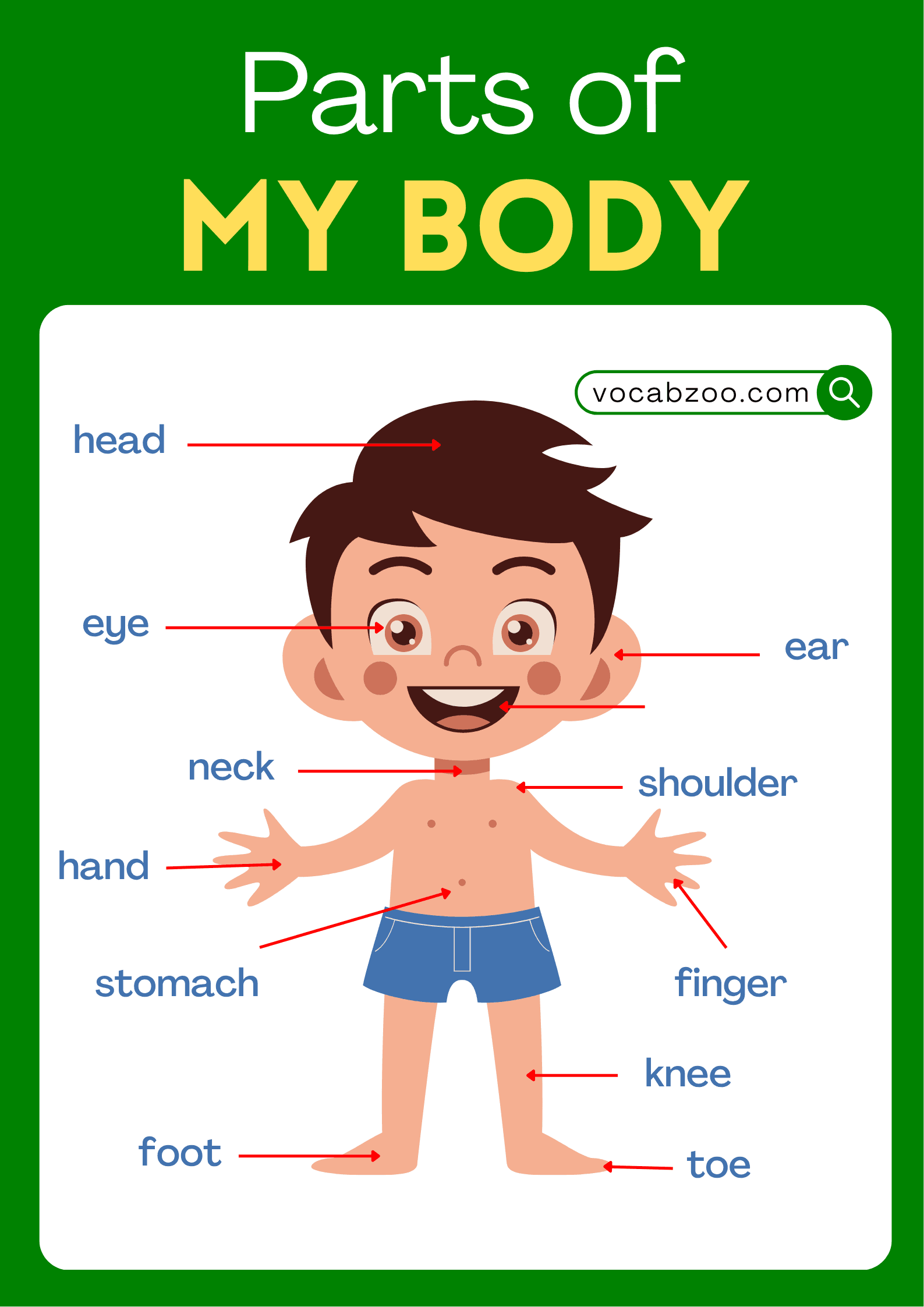
FAQs
What are the main parts of the human body?
The main parts of the body are the head, neck, arms, legs, and torso, which include vital organs like the heart and lungs.
How many parts does the body have?
The human body has many parts, including 206 bones, 600+ muscles, and multiple organs that work together for movement and health.
What are external and internal body parts?
External parts are visible, like the eyes, hands, and feet, while internal parts include organs like the stomach, brain, and heart.
What is the most important part of the body?
The brain is the most important part because it controls all body functions, thoughts, and movements.
How can I learn English body parts easily?
You can learn body parts easily by using pictures, flashcards, and simple sentences like “This is my hand” or “I move my legs.”
Read More
- Colors Name for Kids in English
- Animal Names for Kids with Pictures
- Fruit Names for Kids with Their Pictures

This is such a wonderful and easy-to-understand guide for kids to learn the names of body parts! The pictures really help make the learning fun and clear. Thank you for sharing this — it’s a great resource for parents and teachers to support children’s vocabulary building in English