English has many words that learners find hard to say correctly. In this blog post, you will learn 50 Difficult Words in English to pronounce, along with help to say each word more accurately. These words are often part of advanced vocabulary used in conversations, exams, and formal writing. When you practice their pronunciation, you improve your pronunciation, listening skills, and speaking confidence. Understanding how words sound also helps you read better and avoid common mistakes. Keep reading to learn and practice challenging words that will help you speak English more naturally.
Why Some Words Are Hard to Pronounce
English is a language with words from many sources, like Latin, French, German, and Greek. This mix can make pronunciation confusing. Some reasons words are hard to say include:
- Silent letters: letters that are written but not pronounced.
- Unusual combinations: letters that sound different together than separately.
- Foreign origin: words borrowed from other languages with their own rules.
Example: knight (k is silent) or aisle (ai sounds like “eye”).
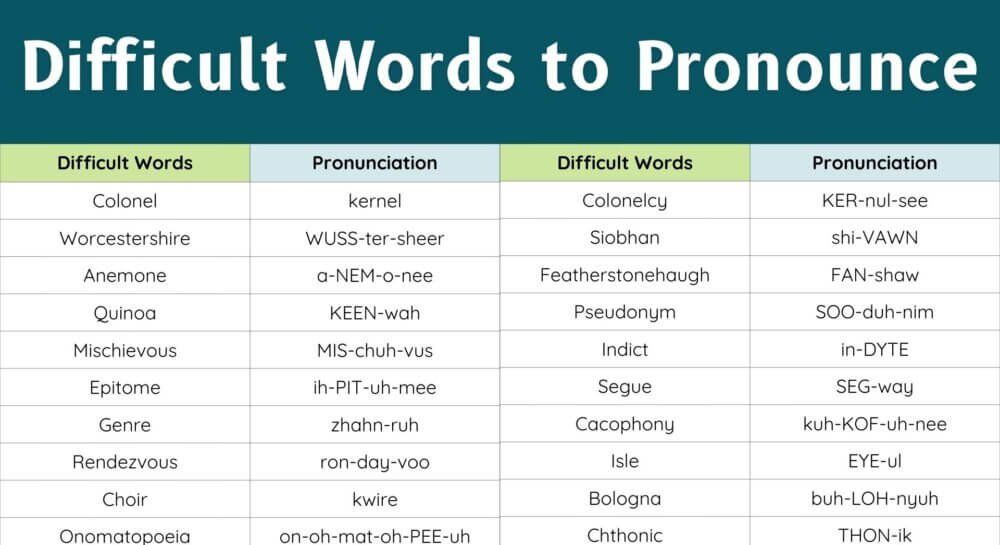
List of Difficult Words with Pronunciation
| Difficult Words | Pronunciation |
|---|---|
| Colonel | kernel |
| Worcestershire | WUSS-ter-sheer |
| Anemone | a-NEM-o-nee |
| Quinoa | KEEN-wah |
| Mischievous | MIS-chuh-vus |
| Epitome | ih-PIT-uh-mee |
| Genre | zhahn-ruh |
| Rendezvous | ron-day-voo |
| Choir | kwire |
| Onomatopoeia | on-oh-mat-oh-PEE-uh |
| Otorhinolaryngologist | oh-toh-rye-no-lar-ing-GOL-uh-jist |
| Hyperbole | hy-PUR-buh-lee |
| Subtle | SUT-tul |
| Fiancé / Fiancée | fee-ahn-say |
| Déjà vu | day-zhah voo |
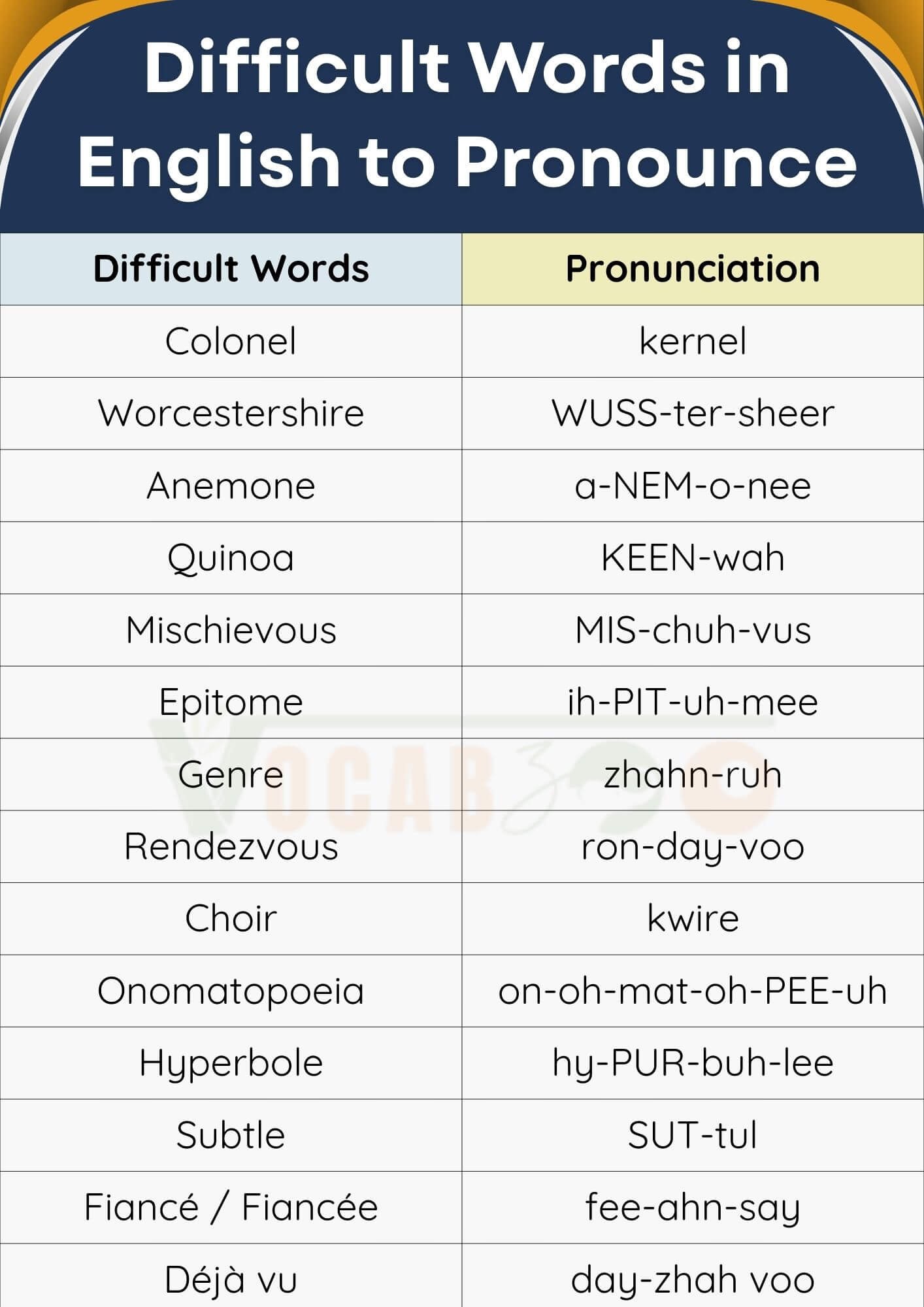
Difficult Words in English to Pronounce
Here’s the list of 50 difficult words in English to pronounce:
Everyday Words
- Wednesday: Often said wrong; sounds like “Wenzday”.
- February: Pronounced “Feb-roo-ary”, not “Feb-yoo-ary”.
- Clothes: Sounds like “cloz” when spoken quickly.
- Choir: Pronounced “kwire”.
- Debt: Silent “b”; say “det”.
- Salmon: Silent “l”; say “sam-on”.
- Island: Silent “s”; say “iland”.
- Subtle: Silent “b”; say “suttle”.
- Receipt: Silent “p”; say “re-seet”.
- Mortgage: Pronounced “mor-gij”.
Academic or Formal Words
- Colonel: Pronounced “kernel”.
- Worcestershire: Pronounced “WUSS-ter-sheer”.
- Anemone: A sea creature; pronounced “a-nem-o-nee”.
- Quinoa: Pronounced “keen-wah”.
- Mischievous: Often mispronounced; say “MIS-chuh-vus”.
- Epitome: Pronounced “ih-PIT-uh-mee”.
- Genre: Pronounced “zhahn-ruh”.
- Rendezvous: Pronounced “ron-day-voo”.
- Coup: Pronounced “koo”.
- Foyer: Pronounced “foy-ay”.
Foreign-Origin Words
- Hors d’oeuvre: Appetizer; pronounced “or-derv”.
- Faux pas: Social mistake; pronounced “foe pah”.
- Bourgeois: Pronounced “boor-zhwah”.
- Croissant: Pronounced “krwa-san”.
- Chauffeur: Pronounced “show-fur”.
- Tsunami: Pronounced “soo-nah-mee”.
- Hors de combat: Pronounced “or duh com-bah”.
- Fiancé / Fiancée: Pronounced “fee-ahn-say”.
- Cliché: Pronounced “klee-shay”.
- Déjà vu: Pronounced “day-zhah voo”.
Science and Technical Words
- Hyperbole: Pronounced “hy-PUR-buh-lee”.
- Onomatopoeia: Pronounced “on-oh-mat-oh-PEE-uh”.
- Otorhinolaryngologist: Pronounced “oh-toh-rye-no-lar-ing-GOL-uh-jist”.
- Phenomenon: Pronounced “fi-NOM-uh-non”.
- Soliloquy: Pronounced “suh-LIL-uh-kwee”.
- Worcester: Pronounced “WUSS-ter”.
- Squirrel: Often hard for non-native speakers; say “skwirl”.
- Isthmus: Pronounced “is-muss”.
- Synecdoche: Pronounced “si-NEK-duh-kee”.
- Hermione: Pronounced “Her-my-oh-nee”.
Miscellaneous Hard Words
- Supercalifragilisticexpialidocious: Fun word from a song; pronounce slowly in parts.
- Antidisestablishmentarianism: Political term; break it into syllables.
- Floccinaucinihilipilification: Means considering something worthless; pronounce slowly.
- Pseudopseudohypoparathyroidism: Rare medical word; break it into parts.
- Sesquipedalian: Describes long words; pronounced “ses-kwi-puh-DAY-lee-an”.
- Defibrillator: Medical device; pronounce “dee-FIB-ri-lay-tor”.
- Cacophony: Pronounced “ka-KOF-uh-nee”.
- Paraphernalia: Pronounced “par-uh-fer-NAY-lee-uh”.
- Isthmian: Pronounced “IS-mee-uhn”.
- Chiaroscuro: Art term; pronounced “kee-ah-ro-SKUR-oh”.
Practice Exercise
- Choose 5 new words from the list.
- Write them in a notebook with phonetic spelling.
- Say each word aloud 3–5 times daily.
- Try using them in sentences.
Example:
- Debt: I paid off my debt yesterday.
- Choir: The school choir sang beautifully.
Conclusion
Pronunciation can be tricky, but learning 50 difficult words helps you speak more confidently. Focus on syllables, silent letters, and foreign-origin words to improve fast. With regular practice, even the hardest words will become easy to say. Keep listening, repeating, and using them in sentences for better results.
FAQs about Difficult Words
What are some of the most difficult words to pronounce in English?
Some of the hardest words to pronounce include colonel, Worcestershire, anemone, epitome, choir, and mischievous. These words have silent letters, unusual spelling, or foreign origins.
How do you pronounce “colonel” correctly?
The word colonel is pronounced “kernel”, even though it is spelled with “c-o-l-o-n-e-l.”
How do you say “Worcestershire” properly?
Worcestershire is pronounced “WUSS-ter-sheer”, not how it looks. Breaking it into syllables helps: WUSS + ter + sheer.
What is the correct pronunciation of “anemone”?
Anemone, a type of sea creature, is pronounced “a-NEM-o-nee”.
How should “epitome” be pronounced in English?
The word epitome is pronounced “ih-PIT-uh-mee”, not “epi-tome.”
How do you say “choir” correctly?
Choir is pronounced “kwire”, not “cho-ir.”
Why are words like “mischievous” and “subtle” hard to pronounce?
Words like mischievous (MIS-chuh-vus) and subtle (SUT-tul) are hard because of silent letters and unexpected syllable stress.
What tips can help me pronounce difficult English words?
Break words into syllables, listen to native speakers, repeat slowly, and practice daily. Focus on silent letters and foreign-origin words like fiancé (fee-ahn-say) and déjà vu (day-zhah voo).
Read More
- Advanced English Words With Sentences and PDF
- 30 Difficult Words with Meanings in English
- 100+ Daily Use Words in Advanced English Words