Learning verbs is essential for speaking and writing English correctly. In this blog post, you will discover 100+ Regular Verbs in English with their meanings and examples to help you understand and use them easily. These verbs are part of important vocabulary that you can apply in daily conversations, writing, and reading. When you practice using regular verbs in sentences, your speaking becomes more confident, your writing becomes clearer, and your listening and reading skills improve. Keep reading to learn useful verbs that will help you communicate effectively and expand your vocabulary.
What Are Regular Verbs in English?
Regular verbs are verbs that form their past tense and past participle by adding -ed to the base form.
Examples:
- Work → worked
- Clean → cleaned
- Talk → talked
They follow a simple rule, which makes them easier to learn than irregular verbs.
Usage of Regular Verbs
Regular verbs are used in many real-life contexts:
Daily routines
I cleaned my room this morning.
Work and study
She completed her project on time.
Social life
We invited our friends to dinner.
Travel
They booked a hotel online.
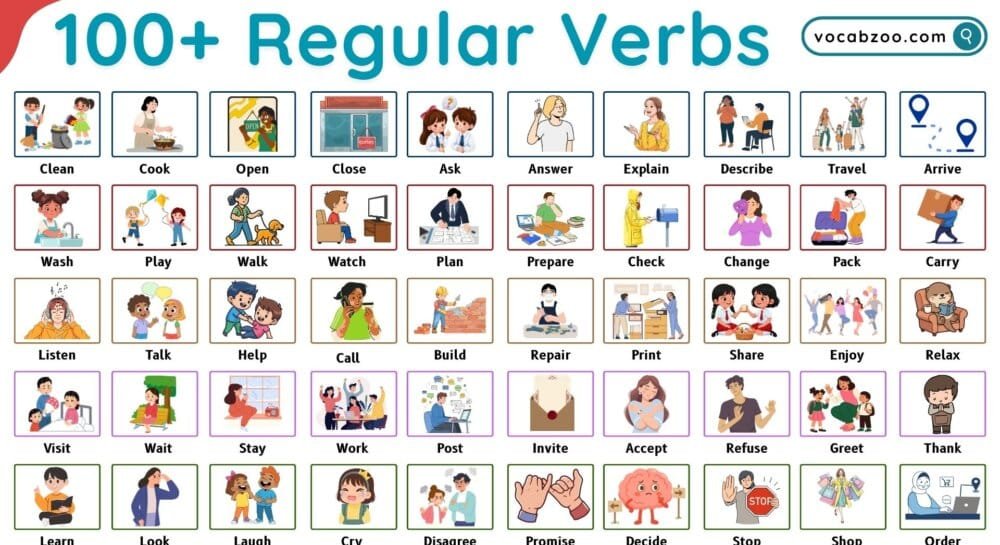
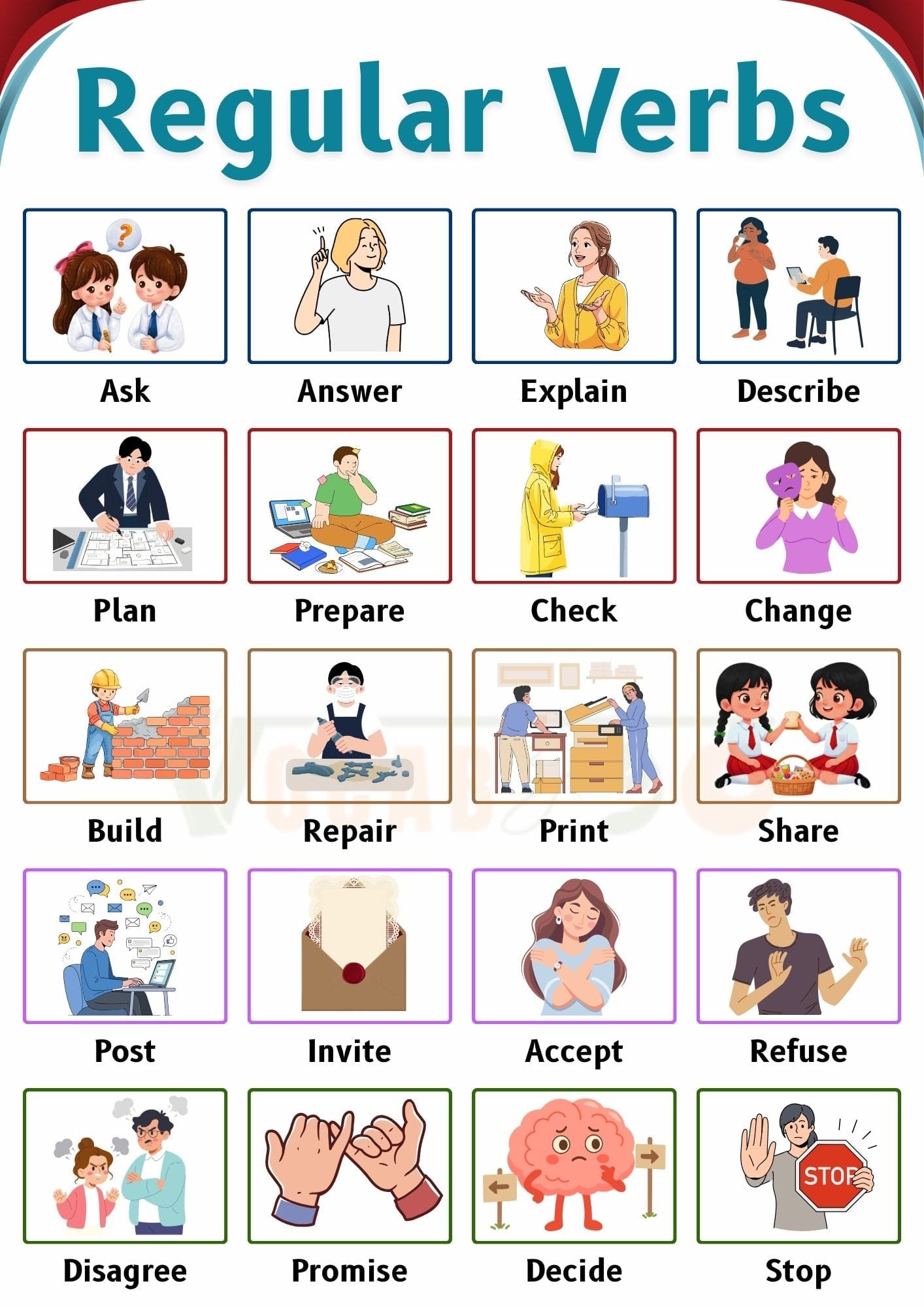
Common Regular Verbs in English with Pictures
These are common daily verbs you often see in pictures and actions.
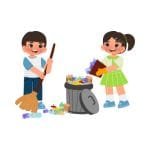
Clean
To remove dirt, dust, or mess from a place or object to make it tidy.
Cook
To prepare food by heating it so it is safe, tasty, and ready to eat.

Open
To move or turn something so you can see, enter, or use what is inside.
Close
To shut something so it is no longer open, active, or easy to enter.

Play
To take part in a game or activity for fun, exercise, or enjoyment.

Walk
To move from one place to another using your feet at a normal speed.

Watch
To look at something carefully for a time, such as a film or people.

Listen
To pay full attention to sounds or words so you can understand them clearly.

Talk
To speak with one or more people to share ideas, feelings, or information.

Help
To make a task easier for someone by giving support, time, or effort.

Call
To use a phone to speak with someone who is in another place.

Work
To do a job or task that needs effort, time, and responsibility.

Study
To spend time learning about a subject by reading, writing, or practising.

Travel
To go from one city, country, or place to another for work or enjoyment.

These verbs are easy to see in action in daily life and pictures.
100 Regular Verbs and Examples
Everyday Actions Verbs with Meanings and Examples
| Verb | Meaning | Example Sentence |
|---|---|---|
| Clean | Make something not dirty | I cleaned the kitchen. |
| Cook | Prepare food | She cooked pasta. |
| Open | Make accessible | He opened the door. |
| Close | Shut something | She closed the window. |
| Wash | Clean with water | I washed my hands. |
| Play | Do an activity for fun | They played football. |
| Walk | Move on foot | We walked to school. |
| Watch | Look at something | I watched a movie. |
| Listen | Pay attention to sound | She listened to music. |
| Talk | Speak | He talked to his friend. |
| Help | Assist someone | I helped my sister. |
| Call | Phone someone | She called her mum. |
| Visit | Go to see someone | We visited our uncle. |
| Wait | Stay until something happens | I waited for the bus. |
| Start | Begin something | He started the car. |
| Finish | End something | She finished her work. |
| Need | Require something | I needed help. |
| Want | Wish for something | They wanted ice cream. |
| Like | Enjoy something | I liked the show. |
| Love | Care deeply | She loved the gift. |
| Try | Make an effort | He tried again. |
| Use | Put something to work | I used my phone. |
| Move | Change position | She moved the chair. |
| Stay | Remain in a place | We stayed home. |
| Work | Do a job | He worked late. |
| Study | Learn about something | I studied English. |
| Learn | Gain knowledge | She learned quickly. |
| Look | See with eyes | He looked outside. |
| Smile | Show happiness | She smiled at me. |
| Laugh | Show joy with sound | They laughed loudly. |
| Cry | Show sadness | The baby cried. |
| Join | Become part of something | I joined the club. |
| Live | Stay in a place | We lived there. |
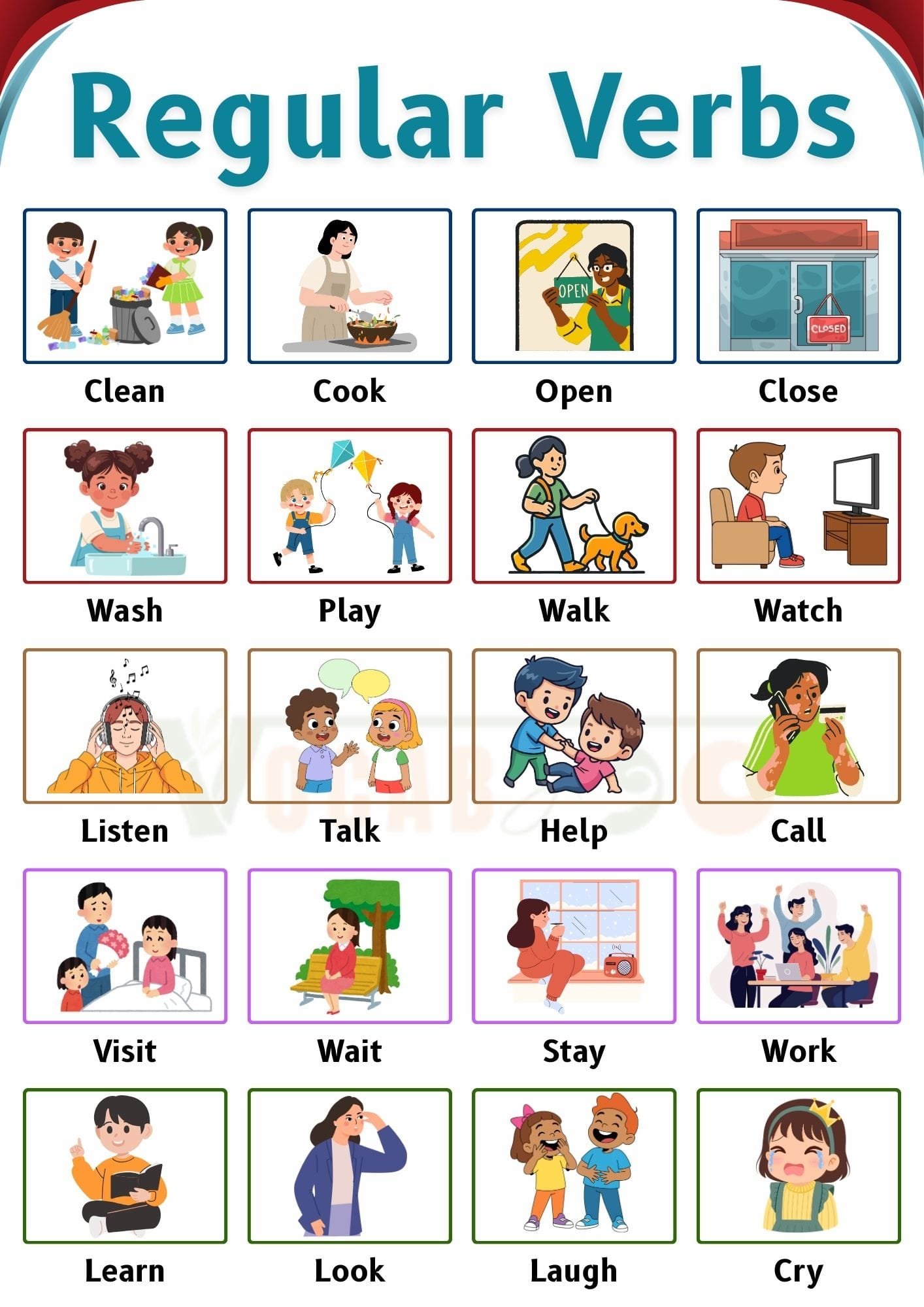
Work, Study, and Communication Verbs
| Verb | Meaning | Example Sentence |
|---|---|---|
| Ask | Request information | She asked a question. |
| Answer | Reply | He answered quickly. |
| Explain | Make something clear | I explained the rule. |
| Describe | Say what something is like | She described the place. |
| Plan | Decide what to do | We planned a trip. |
| Organise | Arrange things | He organised the meeting. |
| Prepare | Get ready | She prepared dinner. |
| Check | Look at something carefully | I checked my email. |
| Change | Make something different | He changed his shirt. |
| Create | Make something new | She created a story. |
| Design | Make a plan or shape | He designed a logo. |
| Build | Make by putting parts together | They built a house. |
| Repair | Fix something | I repaired my bike. |
| Put on paper | She printed the file. | |
| Save | Keep something | I saved the document. |
| Share | Give part to others | He shared the news. |
| Post | Put something online | She posted a photo. |
| Invite | Ask someone to come | We invited our friends. |
| Accept | Say yes to something | He accepted the offer. |
| Refuse | Say no | She refused politely. |
| Agree | Have the same idea | They agreed with me. |
| Disagree | Have a different idea | He disagreed. |
| Promise | Say you will do something | I promised to help. |
| Decide | Choose something | She decided to go. |
| Continue | Keep doing | He continued working. |
| Stop | End an action | They stopped talking. |
| Practise | Do again to improve | I practised speaking. |
| Review | Look again | She reviewed the lesson. |
| Improve | Make better | He improved his skills. |
| Record | Save sound or video | We recorded the song. |
| Translate | Change language | She translated the text. |
| Discuss | Talk about something | They discussed the plan. |
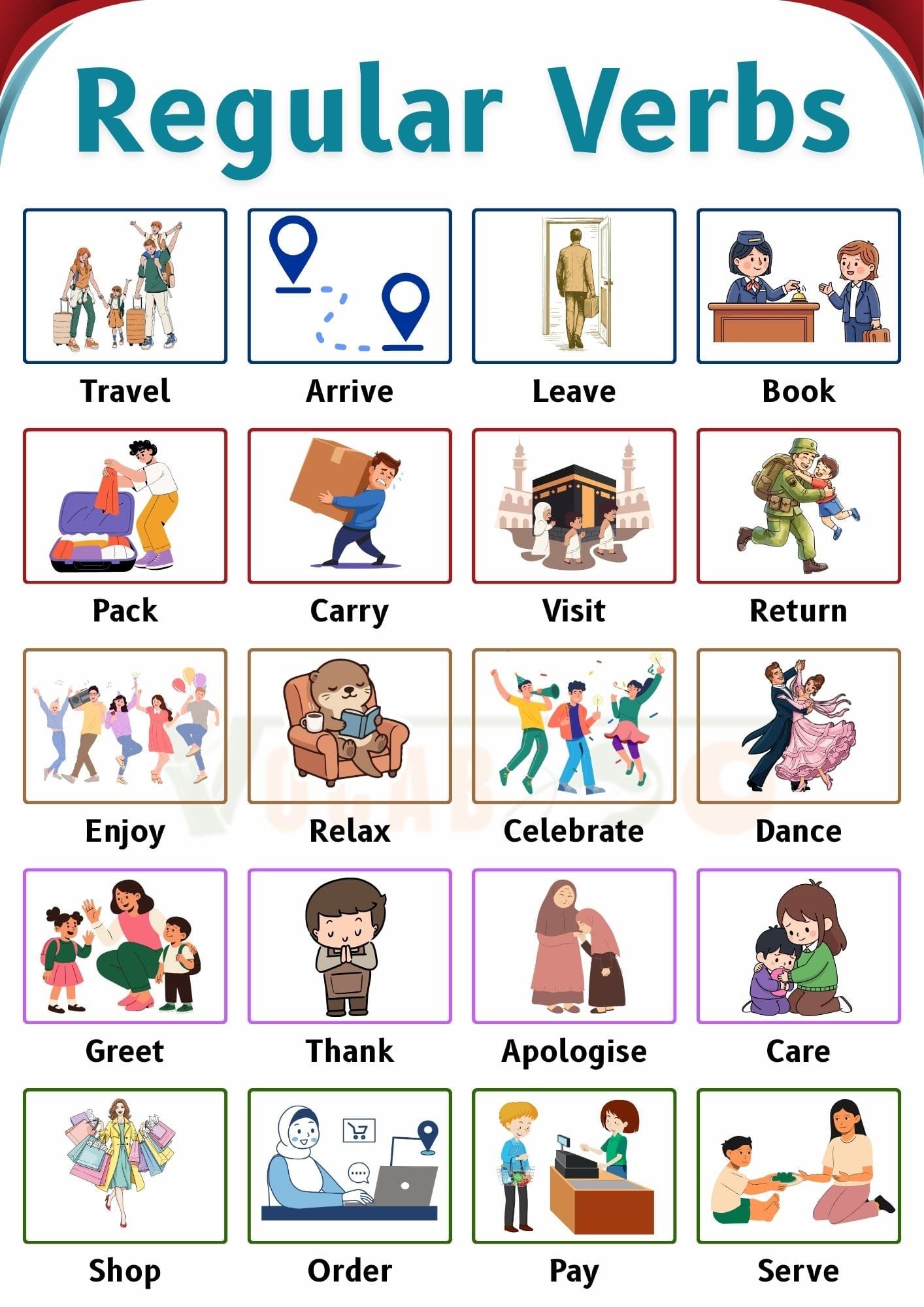
Social Life, Travel, and Home-Related Verbs
| Verb | Meaning | Example Sentence |
|---|---|---|
| Travel | Go to another place | We travelled by train. |
| Arrive | Get to a place | They arrived early. |
| Leave | Go away from a place | She left at noon. |
| Book | Reserve something | I booked a hotel. |
| Pack | Put things in a bag | He packed his clothes. |
| Carry | Hold and move something | She carried the bag. |
| Visit | Go to see someone | We visited Paris. |
| Return | Come back | They returned home. |
| Enjoy | Feel happy about something | I enjoyed the trip. |
| Relax | Rest | She relaxed at home. |
| Celebrate | Mark a special day | We celebrated his birthday. |
| Dance | Move to music | They danced all night. |
| Invite | Ask someone to come | He invited me. |
| Greet | Say hello | She greeted us. |
| Thank | Show thanks | I thanked her. |
| Apologise | Say sorry | He apologised. |
| Care | Look after someone | She cared for the dog. |
| Shop | Buy things | We shopped online. |
| Order | Ask for food or items | He ordered pizza. |
| Pay | Give money | I paid the bill. |
| Serve | Give food | She served tea. |
| Cook | Make food | He cooked soup. |
| Bake | Cook in the oven | She baked a cake. |
| Clean | Make tidy | We cleaned the house. |
| Decorate | Make something look nice | They decorated the room. |
| Water | Give water to plants | I watered the flowers. |
| Plant | Put seeds in soil | He planted trees. |
| Mow | Cut grass | She mowed the lawn. |
| Fix | Repair | I fixed the sink. |
| Paint | Add colour | They painted the wall. |
| Store | Keep something safe | She stored the food. |
| Lock | Close with a key | He locked the door. |
| Unlock | Open with a key | I unlocked the gate. |
Regular vs Irregular Verbs in English
| Feature | Regular Verbs | Irregular Verbs |
|---|---|---|
| Past form rule | Add -ed | No fixed rule |
| Example (Present → Past) | play → played | go → went |
| Past participle | same as past | different form |
| Example in sentence | I talked to her. | I went home. |
Tips to Use Regular Verbs Correctly
- Add -ed for the past: walk → walked
- For verbs ending in e, add -d: love → loved
- For short verbs with one vowel and one consonant, double the consonant: stop → stopped
Conclusion
Regular verbs are the building blocks of clear and confident English. With these 100+ regular verbs, their meanings, and everyday examples, you can speak about your daily life, work, travel, and social activities easily. Keep practising a few verbs each day, and you will see fast improvement in your English skills.
FAQs about Regular Verbs
What are regular verbs and examples?
Regular verbs are verbs that form their past tense and past participle by adding -ed to the base form. For example: clean → cleaned → cleaned, work → worked → worked, play → played → played, talk → talked → talked, and watch → watched → watched. These verbs follow a simple and predictable pattern.
What is a regular and irregular verb?
A regular verb adds -ed to make the past form, like open → opened and help → helped. An irregular verb does not follow this rule and changes form, like go → went, eat → ate, and see → saw. Regular verbs are easier to learn because they follow one clear rule.
What are the 20 regular verbs?
Here are 20 common regular verbs: clean, cook, open, close, play, walk, watch, listen, talk, help, call, work, study, travel, plan, start, finish, learn, move, and visit. All of these form their past tense by adding -ed.
What is the rule for regular verbs in English?
The main rule is to add -ed to the base verb to make the past tense and past participle. For example, wash → washed, talk → talked, visit → visited. If a verb ends in e, you only add -d, like love → loved.
Regular verbs List V1 V2 V3 – what does it mean?
V1 is the base form, V2 is the past simple form, and V3 is the past participle. For regular verbs, V2 and V3 are the same. Example list: clean – cleaned – cleaned, work – worked – worked, play – played – played, help – helped – helped, talk – talked – talked.
Read More:
- 200+ List of Irregular Verbs in English with PDF
- Regular Verbs List V1 V2 V3 – Pictures and PDF
- Classroom Verbs in English with Pictures