
Learning English vocabulary is an important part of improving speaking, writing, reading, and listening skills. Many students learn new words every day but forget them quickly because they do not use the right learning methods. The good thing is that remembering vocabulary does not have to be difficult. With simple daily habits like reading, speaking, revision, and using words in real sentences, anyone can learn and remember English vocabulary faster. In this article, you will learn Easy Tips to Remember English Vocabulary Faster that can help beginners and advanced learners improve their vocabulary naturally and confidently.
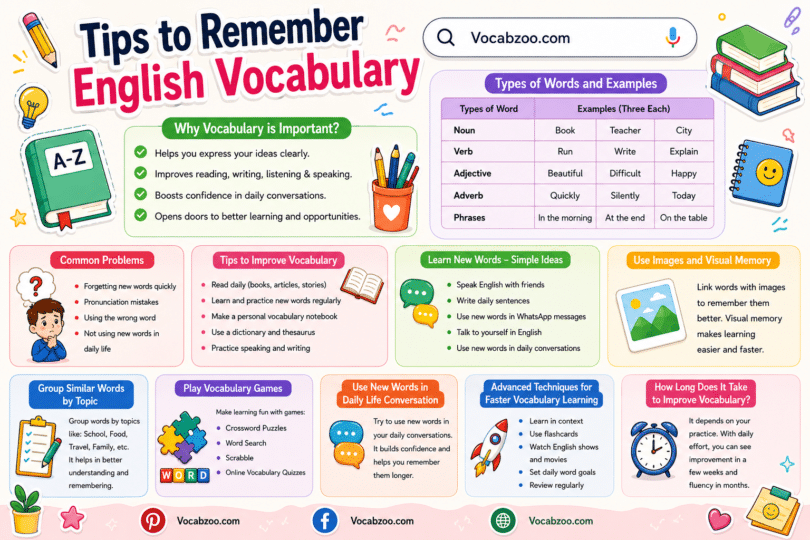
Why Vocabulary Is Important in English Learning
Vocabulary is the foundation of every language. Without enough words, it becomes difficult to:
- Understand English books and articles
- Speak confidently
- Write correct sentences
- Improve listening skills
- Score well in exams
A strong vocabulary helps learners express ideas clearly and communicate naturally.
What Vocabulary Means
Vocabulary refers to the collection of words a person knows and uses in a language. These words include:
| Type of Word | Example |
|---|---|
| Nouns | book, teacher, city |
| Verbs | run, write, explain |
| Adjectives | beautiful, difficult, quick |
| Adverbs | slowly, carefully |
| Phrases | look after, give up |
The more words you know, the easier English becomes.
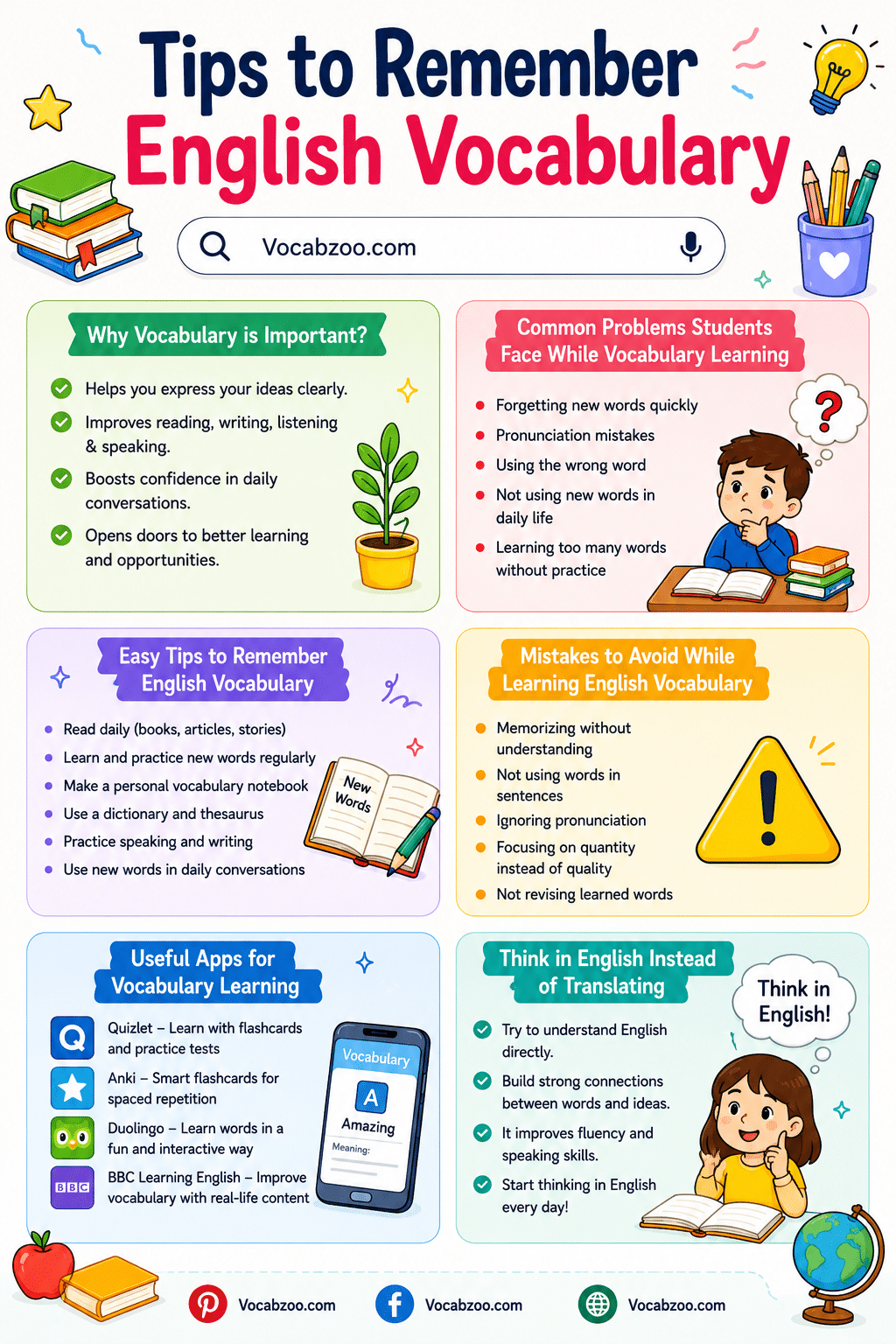
Common Problems Students Face While Learning Vocabulary
Many learners face these problems:
- Forgetting words after a few days
- Memorizing without understanding
- Learning difficult words without practice
- Not using new vocabulary in daily life
- Translating every word into their native language
These issues slow down learning. However, simple vocabulary techniques can solve them.
Easy Tips to Remember English Vocabulary Faster
Learn Words in Context, Not Alone
One of the biggest mistakes learners make is memorizing isolated words. It is better to learn words inside sentences.
Example
Instead of learning:
- “Generous = kind”
Learn:
- “My friend is generous because he helps poor people.”
This helps your brain understand how the word is used naturally.
Why This Method Works
- Improves memory
- Builds sentence structure
- Helps in speaking and writing
- Makes learning more meaningful
Use New Words in Daily Conversation
Words become permanent when you actively use them.
Simple Practice Ideas
- Speak English with friends
- Write daily sentences
- Use new words in WhatsApp messages
- Talk to yourself in English
Example
If you learn the word “confident”, try saying:
- “I feel confident before my exam.”
The more you use a word, the stronger your memory becomes.
Learn Only a Few Words Every Day
Do not try to memorize 100 words in one day. Your brain remembers better when learning happens slowly and regularly.
Recommended Daily Goal
| Level | Words Per Day |
|---|---|
| Beginner | 5 words |
| Intermediate | 10 words |
| Advanced | 15 words |
Consistency is more important than quantity.
Create Personal Sentences
When you connect vocabulary with your own life, the word becomes easier to remember.
Example
Word: Excited
Personal sentence:
- “I am excited about my summer vacation.”
This creates an emotional connection with the word.
Use Flashcards for Quick Revision
Flashcards are small cards that contain:
- A word on one side
- Meaning or sentence on the other side
You can create physical flashcards or use apps like:
- Quizlet
- Anki
- Memrise
Benefits of Flashcards
- Fast revision
- Easy portability
- Better repetition
- Improves long-term memory
Learn Synonyms and Antonyms Together
Learning related words helps your brain build connections.
Example Table
| Word | Synonym | Antonym |
|---|---|---|
| Happy | joyful | sad |
| Strong | powerful | weak |
| Fast | quick | slow |
This method also improves writing quality.
Read English Every Day
Reading is one of the best ways to increase vocabulary naturally.
Best Reading Sources
- Story books
- English blogs
- Newspapers
- ESL articles
- Short novels
When reading:
- Highlight unfamiliar words
- Guess their meaning from context
- Check the meaning later
- Use the word in a sentence
Watch English Videos With Subtitles
Listening and reading together improve vocabulary retention.
Recommended Content
- English movies
- YouTube educational channels
- TED Talks
- Podcasts
- English cartoons for beginners
Subtitles help learners understand pronunciation and spelling at the same time.
Keep a Vocabulary Notebook
A vocabulary notebook helps organize your learning.
What to Write in Your Notebook
| Include | Example |
|---|---|
| New word | Accurate |
| Meaning | Correct and exact |
| Sentence | “Her answer was accurate.” |
| Synonym | Correct |
| Antonym | Wrong |
Review your notebook regularly.
Revise Words Again and Again
Revision is necessary because the brain forgets information over time.
Best Revision Schedule
- Review after 1 day
- Review after 3 days
- Review after 1 week
- Review after 1 month
Repeated exposure moves vocabulary into long-term memory.
Learn Word Families
Understanding word forms helps learners use vocabulary correctly.
Example
| Word Family | Type |
|---|---|
| Educate | Verb |
| Education | Noun |
| Educational | Adjective |
| Educator | Noun |
This technique improves grammar and writing skills together.
Use Images and Visual Memory
The brain remembers pictures faster than plain text.
Example
If you learn the word “apple”, imagine a red apple in your mind.
Visual memory works especially well for beginners and children.
Practice Spelling and Pronunciation Together
Many learners know a word’s meaning but cannot pronounce or spell it correctly.
Example
Word: Environment
Practice:
- Read aloud
- Write it three times
- Use it in a sentence
This improves:
- Speaking
- Listening
- Writing
- Confidence
Group Similar Words by Topic
Topic-based learning improves understanding.
Example Topics
| Topic | Vocabulary |
|---|---|
| Education | teacher, exam, student |
| Travel | airport, ticket, luggage |
| Health | medicine, doctor, exercise |
Your brain remembers connected information more easily.
Play Vocabulary Games
Games make learning fun and less stressful.
Useful Vocabulary Games
- Crossword puzzles
- Word search
- Scrabble
- Online vocabulary quizzes
Games improve focus and memory naturally.
Advanced Techniques for Faster Vocabulary Learning
Learn Prefixes and Suffixes
Understanding word parts helps you guess meanings of unfamiliar words.
Common Prefixes
| Prefix | Meaning | Example |
|---|---|---|
| Un- | Not | unhappy |
| Re- | Again | rewrite |
| Pre- | Before | preview |
Common Suffixes
| Suffix | Meaning | Example |
|---|---|---|
| -ful | Full of | helpful |
| -less | Without | careless |
| -ment | Result/action | development |
This method is very useful for academic English.
Think in English Instead of Translating
Direct translation slows vocabulary development.
Try to connect English words directly with ideas or images.
Example
Instead of:
- English → Native language → Meaning
Train your brain:
- English → Meaning
This improves fluency and speaking speed.
Use Spaced Repetition Technique
Spaced repetition means reviewing words at increasing intervals.
This scientific learning method improves long-term memory.
Example Schedule
| Review Number | Time |
|---|---|
| 1st Review | Same day |
| 2nd Review | After 1 day |
| 3rd Review | After 3 days |
| 4th Review | After 1 week |
Advanced Techniques for Faster Vocabulary Learning
Mistakes to Avoid While Learning Vocabulary
Memorizing Without Practice
Words disappear quickly if not used.
Always practice speaking and writing.
Learning Very Difficult Words First
Start with common and useful vocabulary before advanced academic words.
Ignoring Pronunciation
Correct pronunciation is important for communication and listening skills.
Studying Without Revision
Revision is necessary for permanent learning.
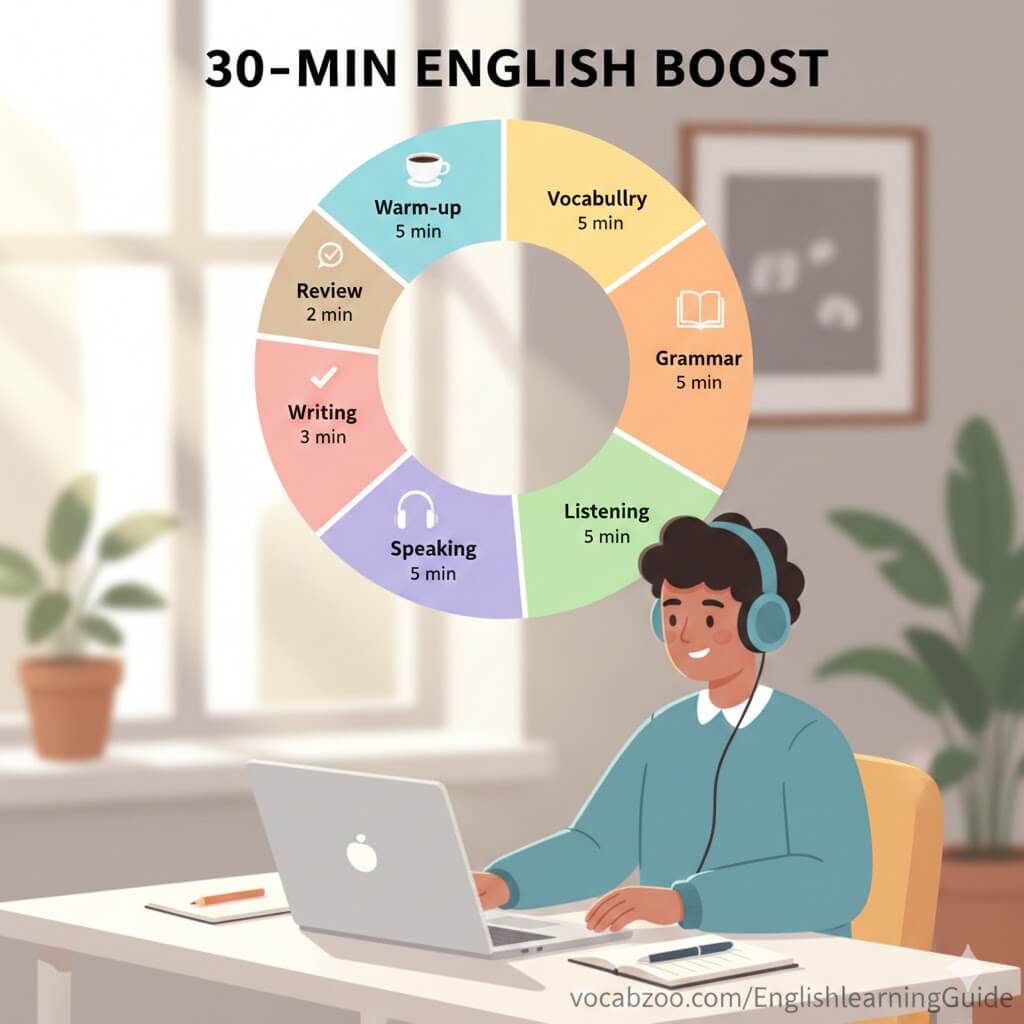
Best Daily Routine to Improve Vocabulary
Morning
- Learn 5–10 new words
- Read meanings and examples
Afternoon
- Use words in sentences
- Practice pronunciation
Evening
- Revise old vocabulary
- Read English content
Even 20–30 minutes daily can create huge improvement over time.
Useful Apps for Vocabulary Learning
| App | Purpose |
|---|---|
| Quizlet | Flashcards |
| Anki | Spaced repetition |
| Duolingo | Beginner practice |
| Memrise | Vocabulary games |
| BBC Learning English | Real English lessons |
These tools make learning interactive and enjoyable.
How Long Does It Take to Improve Vocabulary?
Vocabulary improvement depends on:
- Daily practice
- Reading habits
- Revision
- Motivation
- Consistency
Students who practice regularly usually notice improvement within a few weeks.