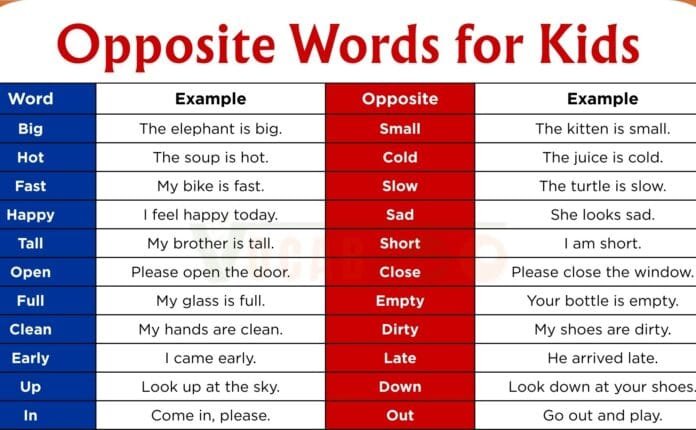
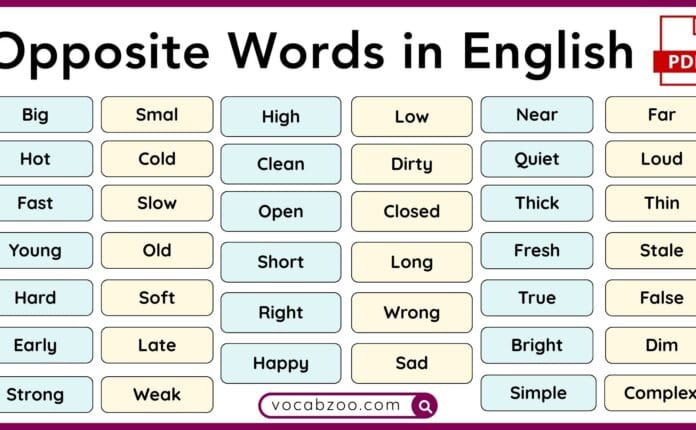
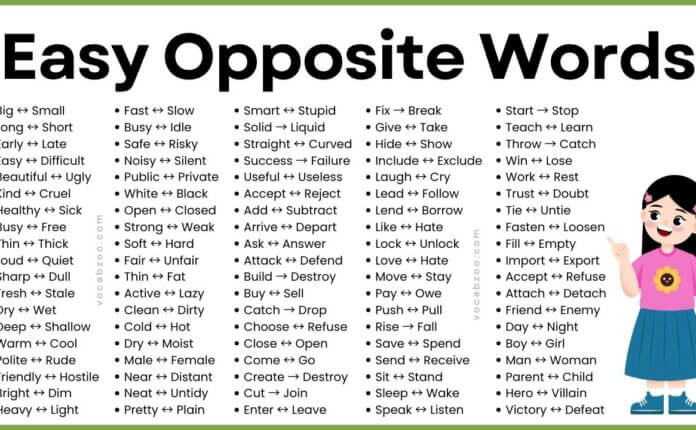
Understanding opposite meanings is an important part of English Vocabulary, and learning 100 Most Common Antonyms in English with Their Examples helps you use words more precisely. In this blog post, you will see each antonym with examples, making it easier to learn and remember how they are used. Knowing these words improves speaking, reading, and writing skills, and allows you to describe things clearly, understand texts, and express ideas accurately. Mastering common antonyms makes your English more expressive and confident.
100 Most Common Antonyms in English
| Word | Antonym |
|---|---|
| Hot | Cold |
| Big | Small |
| Fast | Slow |
| Happy | Sad |
| Light | Dark |
| Early | Late |
| Empty | Full |
| High | Low |
| Open | Closed |
| Rich | Poor |
| Clean | Dirty |
| Up | Down |
| Win | Lose |
| Hard | Soft |
| Tall | Short |
| Thick | Thin |
| New | Old |
| Young | Old |
| Brave | Cowardly |
| Beautiful | Ugly |
| Kind | Cruel |
| Heavy | Light |
| In | Out |
| Right | Wrong |
| Wet | Dry |
| Loud | Quiet |
| Near | Far |
| Safe | Dangerous |
| Wide | Narrow |
| Buy | Sell |
| Give | Take |
| Begin | End |
| Strong | Weak |
| Alive | Dead |
| Win | Fail |
| Above | Below |
| Agree | Disagree |
| Accept | Reject |
| Add | Subtract |
| Arrive | Depart |
| Best | Worst |
| Birth | Death |
| Bright | Dull |
| Clever | Stupid |
| Deep | Shallow |
| Difficult | Easy |
| Enter | Exit |
| Fact | Fiction |
| Friend | Enemy |
100 Examples of Antonyms
| Word | Antonym |
|---|---|
| Healthy | Sick |
| Honest | Dishonest |
| Inside | Outside |
| Love | Hate |
| Maximum | Minimum |
| Modern | Ancient |
| Natural | Artificial |
| Neat | Messy |
| Pass | Fail |
| Present | Absent |
| Private | Public |
| Profit | Loss |
| Quick | Slow |
| Raise | Lower |
| Save | Spend |
| Secure | Insecure |
| Serious | Funny |
| Simple | Complicated |
| Smooth | Rough |
| Start | Stop |
| Sweet | Bitter |
| Thick | Thin |
| Together | Apart |
| Truth | Lie |
| Useful | Useless |
| Victory | Defeat |
| Visible | Invisible |
| Win | Lose |
| Work | Rest |
| Always | Never |
| Asleep | Awake |
| Attentive | Inattentive |
| Back | Front |
| Below | Above |
| Brave | Fearful |
| Careful | Careless |
| Create | Destroy |
| Day | Night |
| Demand | Supply |
| Dry | Wet |
| East | West |
| Expand | Shrink |
| Exclude | Include |
| Float | Sink |
| Gain | Lose |
| Generous | Stingy |
| Gently | Roughly |
| Go | Stop |
| Happy | Unhappy |
| Hope | Despair |
| Increase | Decrease |
| Join | Separate |
50 Common Antonyms in English with Their Examples
Learn Opposite Words with Easy Sentences You Can Use Every Day.
Understand / Misunderstand
- Understand: I understand your point.
- Misunderstand: Don’t misunderstand my words.
Accept / Reject
- Accept: He accepted the job offer.
- Reject: She rejected the idea without thinking.
Win / Lose
- Win: Our team can win the game.
- Lose: I don’t like to lose.
Buy / Sell
- Buy: I want to buy a new phone.
- Sell: He sells fresh fruits in the market.
Open / Close
- Open: Please open the door.
- Close: Close your book after reading.
Happy / Sad
- Happy: She looks happy today.
- Sad: He felt sad after the test.
Begin / End
- Begin: Let’s begin the class now.
- End: The movie ended at 9 PM.
Fast / Slow
- Fast: He runs very fast.
- Slow: This computer is too slow.
Love / Hate
- Love: I love reading books.
- Hate: They hate loud music.
Give / Take
- Give: Give me your notebook.
- Take: Please take a seat.
Easy / Difficult
- Easy: That was an easy question.
- Difficult: Some words are difficult to spell.
Arrive / Depart
- Arrive: The bus will arrive soon.
- Depart: The train departs at 5 PM.
Young / Old
- Young: My little brother is very young.
- Old: My grandfather is 80 years old.
Clean / Dirty
- Clean: I like to keep my room clean.
- Dirty: His shoes are dirty after walking in the mud.
Safe / Dangerous
- Safe: This area is safe for kids.
- Dangerous: That animal looks dangerous.
Day / Night
- Day: We go to school during the day.
- Night: It’s dark at night.
Strong / Weak
- Strong: He is strong enough to lift the box.
- Weak: I feel weak after being sick.
Near / Far
- Near: The store is near my house.
- Far: His school is far from home.
Light / Heavy
- Light: This bag is light and easy to carry.
- Heavy: The box is too heavy to lift.
Sweet / Bitter
- Sweet: I love sweet apples.
- Bitter: This medicine tastes bitter.
FAQs About Antonyms
What are antonyms in English?
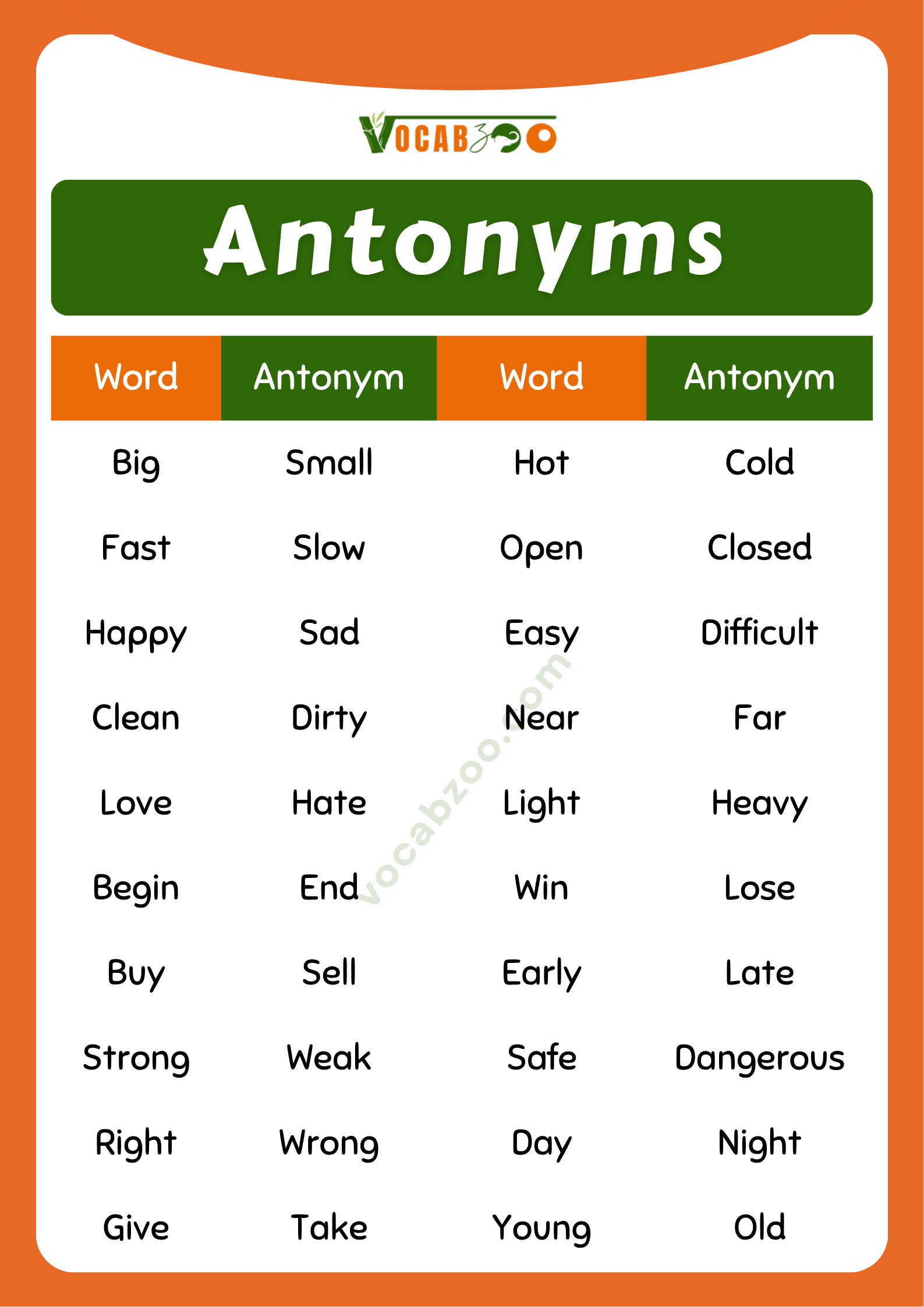
Antonyms are words that have opposite meanings, like hot and cold or happy and sad.
Why should I learn antonyms?
Learning antonyms helps you improve your vocabulary and makes your speaking and writing more clear and correct.
How can I remember antonyms easily?
Practice with simple pairs, read example sentences, and use them in your daily conversation.
Read More: