Action words make your English more expressive and help you describe what people do. In this blog post, you will learn 100 Action Verbs in English with pictures and examples to help you understand and remember each verb easily. These action verbs are used in speaking, writing, reading, and listening every day. When you practice using them in sentences, your speaking becomes more confident, your writing clearer, and your overall vocabulary stronger. Keep reading to learn useful verbs that will help you communicate effectively in any situation.
Action verbs are words that show an action, movement, or activity. They tell us what the subject is doing. For example:
She runs every morning.
They build a house.
Action verbs are used in spoken English, written sentences, instructions, and stories. They make language clear, active, and easy to understand.
Common Action Verbs in English with Pictures
These are some of the most used action verbs in daily English.
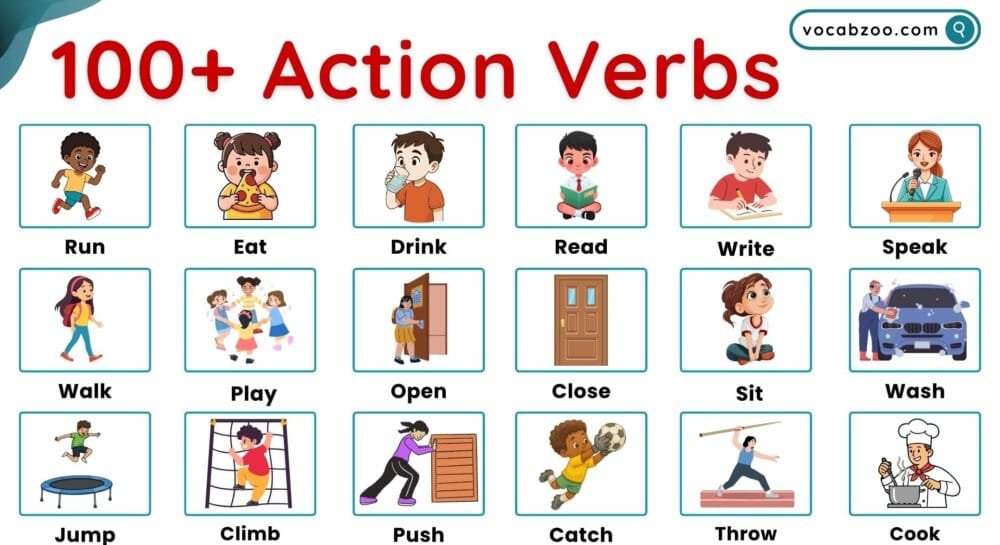
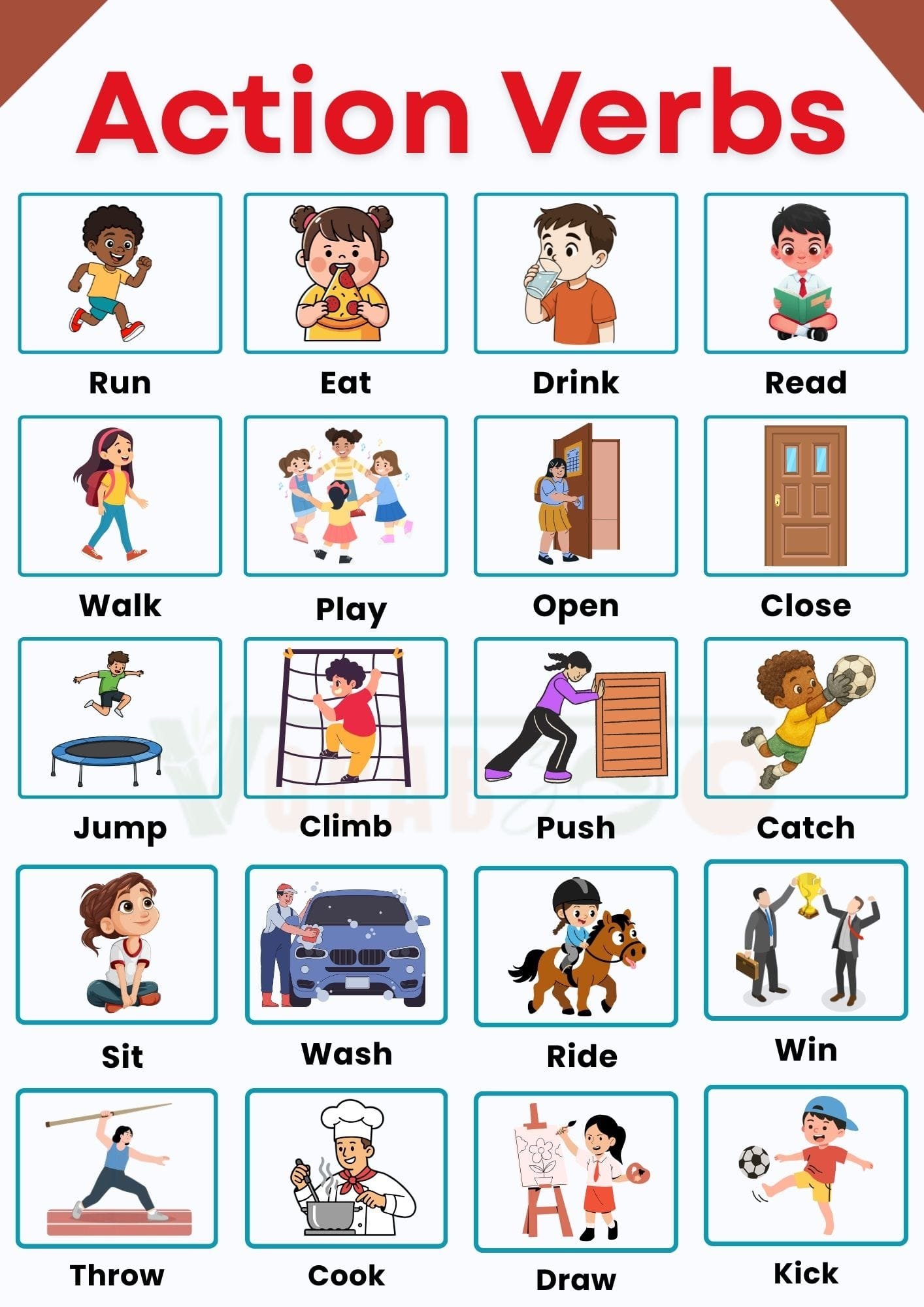
Run Move fast on feet, often used for exercise or reaching places quickly
Eat Put food in mouth and swallow to get energy
Drink Take liquid into the mouth and swallow
Read Look at words and understand their meaning
Write Form letters or words on paper or screen
Speak Say words to express thoughts or ideas
Walk Move slowly using feet, usually for short distances
Play Do an activity for fun or enjoyment
Open Move something to allow access inside
Close Shut something to stop access
Sit Rest body on a chair or surface
Types of Action Verbs with Meanings
Physical Action Verbs
These verbs describe body movements and physical activities.
Jump: push body into the air using legs
Run: move quickly using legs
Walk: move forward at a slow speed
Climb: move up using hands and feet
Kick: hit something using the foot
Throw: send something through the air with hand
Catch: stop and hold a moving object
Push: move something away using force
Pull: bring something closer using force
Lift: raise something to a higher position
Bend: move body part into a curved position
Stretch: extend arms or legs to full length
Daily Routine Action Verbs
These verbs are used in everyday life and habits.
Wake: stop sleeping and open eyes
Sleep: rest body and mind at night
Brush: clean teeth or hair using a brush
Wash: clean body or objects with water
Wear: have clothes on the body
Cook: prepare food using heat
Clean: remove dirt from a place or object
Shop: buy items from stores
Drive: control a car or vehicle
Relax: rest body and mind
Work: do a job or task
Rest: stop activity to regain energy
Communication Action Verbs
These verbs help express ideas and feelings.
Speak: say words clearly to others
Talk: have a conversation with someone
Ask: request information or help
Answer: reply to a question
Explain: make something clear and easy to understand
Tell: give information or instructions
Call: contact someone by phone
Listen: pay attention to sounds or speech
Shout: speak loudly
Whisper: speak very quietly
Learning and Thinking Action Verbs
These verbs relate to the mind and learning process.
Learn: gain new knowledge or skills
Study: spend time learning a subject
Think: use mind to form ideas
Understand: know the meaning of something
Remember: keep information in the mind
Forget: fail to remember something
Know: have information or awareness
Decide: choose after thinking
Plan: think about future actions
Practice: repeat actions to improve skills
Work and Study Action Verbs
These verbs are common in schools and workplaces.
Write: create text using pen or keyboard
Read: understand written information
Draw: make pictures using pencil or pen
Build: make something by joining parts
Fix: repair something broken
Use: apply something for a purpose
Finish: complete a task
Start: begin an activity
Help: give support to someone
Check: look at something carefully
Sports and Outdoor Action Verbs
These verbs are used in games and outdoor activities.
Play: take part in a game or sport
Run: move fast during sports
Score: get points in a game
Swim: move through water using arms and legs
Ride: sit and control a bike or animal
Hit: strike something with force
Train: practise to improve skills
Compete: try to win against others
Win: achieve victory
Lose: fail to win
Home and Kitchen Action Verbs
These verbs are common at home and in cooking.
Cook: prepare meals using heat
Bake: cook food in an oven
Boil: heat liquid until bubbles appear
Cut: divide something using a knife
Mix: combine ingredients together
Serve: give food to others
Clean: remove dirt from home areas
Organise: arrange items neatly
Decorate: make a place look nice
Repair: fix broken household items
Travel and Movement Action Verbs
These verbs describe movement and travel.
Go: move from one place to another
Come: move towards a place or person
Arrive: reach a destination
Leave: go away from a place
Travel: go to different places
Enter: go inside a place
Exit: go out of a place
Move: change position
Stop: end movement
Return: go back to a place
Action Verbs Examples in Sentences
Here’s the list of some important action words with examples in sentences:
Run: I run to the bus stop every morning to catch the bus.
Eat: We usually eat dinner together after work.
Drink: Please drink some water if you feel tired.
Read: I read a short story before going to bed.
Write: She writes her homework in a notebook.
Speak: He speaks clearly during the meeting.
Walk: Let’s walk to the nearby shop after lunch.
Play: The children play in the park every evening.
Open: Can you open the window for fresh air?
Close: Please close the door when you leave.
Sit: You can sit here while you wait.
Stand: We stand in line to buy tickets.
List of Action Verbs with Pictures
Conclusion
Action verbs are used in daily conversations, school lessons, instructions, and stories. By learning these 100 action verbs, you can describe actions clearly and speak English with more confidence. Regular practice with simple sentences, pictures, and real-life examples makes learning faster and more enjoyable.
FAQs about Action Verbs
What is an action verb? An action verb shows what a person, animal, or thing does. Words like run, eat, write, speak, walk, and play describe actions in sentences.
What are the 20 action verbs? Some common action verbs are run, walk, eat, drink, read, write, speak, listen, play, open, close, sit, stand, jump, work, study, cook, clean, drive, sleep.
What are physical action verbs in English? Physical action verbs describe body movement, such as run, jump, walk, climb, push, pull, throw, and lift. These verbs show clear physical activity.
What are daily routine action verbs? Daily routine action verbs describe everyday habits like wake, sleep, eat, drink, wash, brush, work, and relax. They are common in daily conversation.
What are communication action verbs? Communication action verbs show how people share ideas, such as speak, talk, ask, answer, explain, tell, listen, and call.
What are learning and thinking action verbs? Learning and thinking action verbs describe mental actions like learn, study, think, understand, remember, decide, and plan. These verbs are often used in school and work.
Matloob is a Mentor at vocabzoo.com, where learning English becomes fun and easy. With over 7 years of experience in research, English lessons, and content writing, Matloob is dedicated to helping English learners build their skills with confidence.