
Building strong language skills requires learning higher-level words that are used in academic and professional settings. In this blog post, you will learn Advanced English Words with meaningful sentences and a downloadable PDF for practice. These words are part of advanced vocabulary that helps you express ideas more precisely and confidently. When you understand how to use them in sentences, you improve your writing, strengthen your speaking, and develop better reading and listening skills. Regular practice will help you master complex words step by step. Keep reading to expand your word knowledge and communicate with greater accuracy.
Advanced English Words With Sentences
Here’s the list of the most advanced English words with their use in sentences:
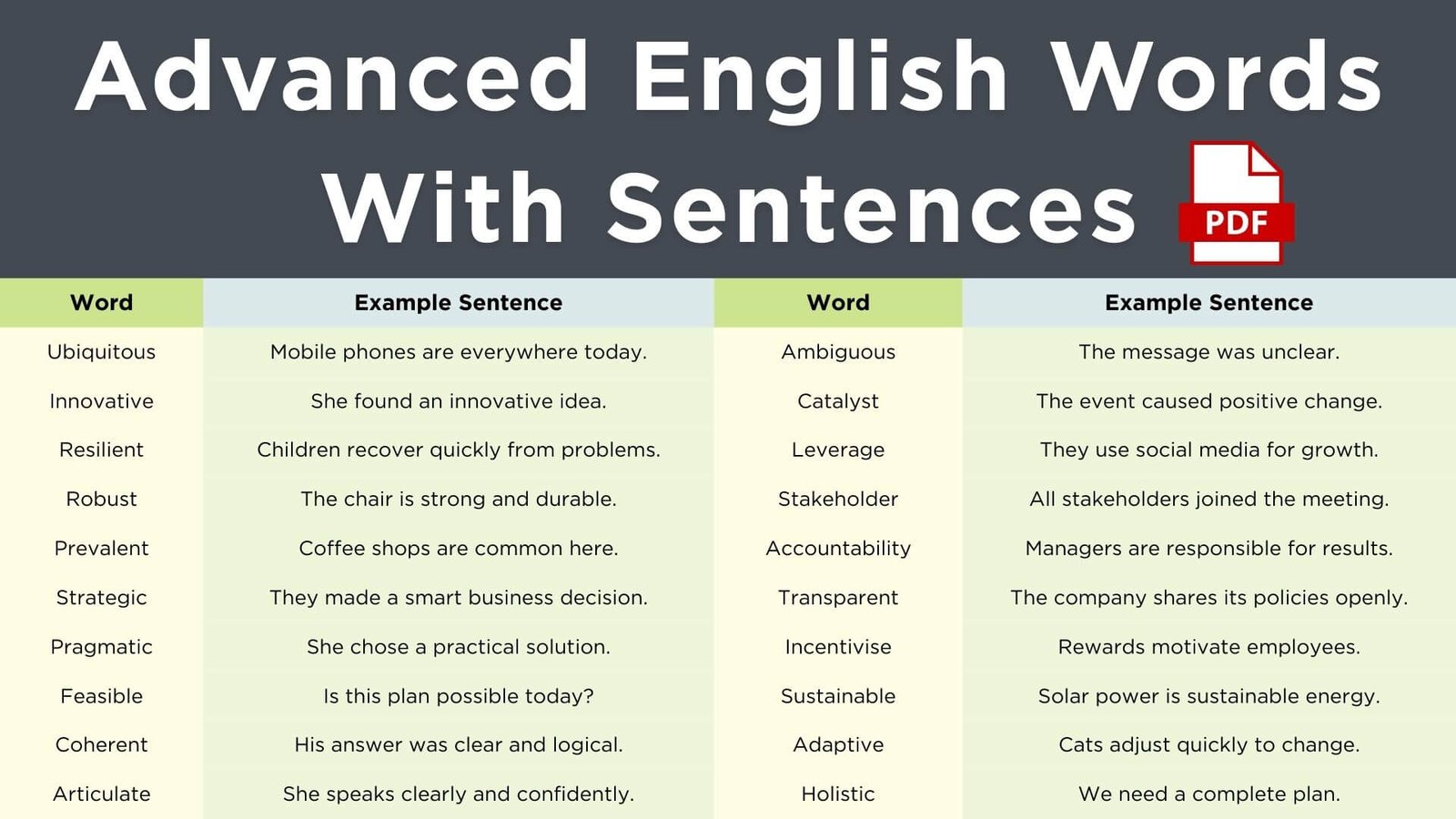
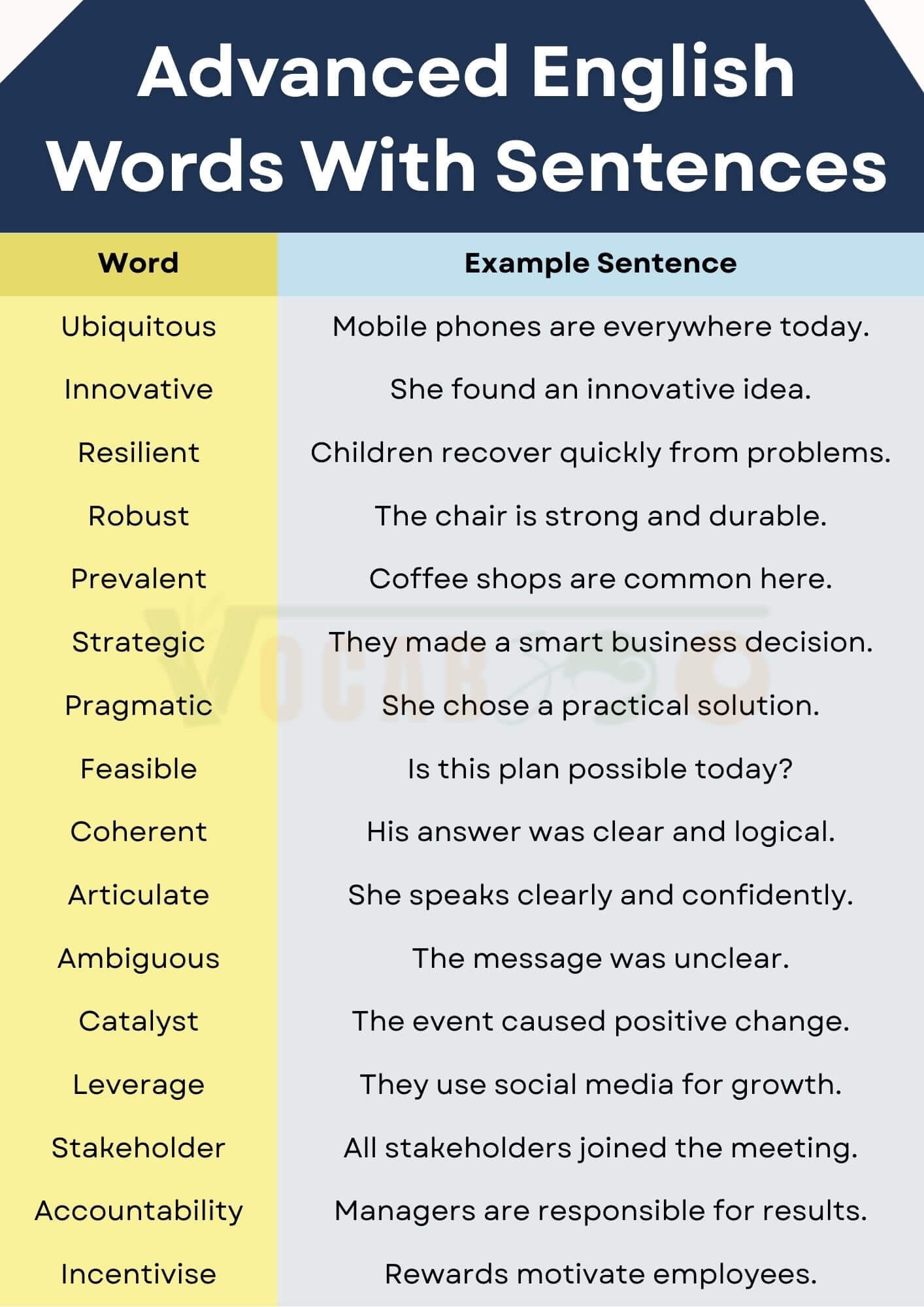
| Word | Example Sentence |
|---|---|
| Ubiquitous | Mobile phones are ubiquitous in modern life. |
| Innovative | She came up with an innovative solution to the problem. |
| Resilient | Children can be very resilient after a tough experience. |
| Robust | He built a robust table that won’t break easily. |
| Prevalent | Coffee shops are prevalent in every city. |
| Strategic | They made a strategic decision to expand their business. |
| Pragmatic | She took a pragmatic approach to solve the issue. |
| Feasible | Is it feasible to finish the work in one day? |
| Coherent | His explanation was simple and coherent. |
| Articulate | She is very articulate and speaks confidently. |
| Ambiguous | The instructions were ambiguous, so we got confused. |
| Catalyst | His speech was a catalyst for positive change. |
| Leverage | They want to leverage social media for marketing. |
| Stakeholder | All stakeholders should be informed about the meeting. |
| Accountability | Managers have accountability for their team’s performance. |
| Transparent | The company is transparent about its policies. |
| Incentivise | Bonuses incentivise employees to work harder. |
| Sustainable | They are looking for sustainable energy solutions. |
| Adaptive | Cats are very adaptive to new environments. |
| Holistic | We need a holistic plan for the project. |
Advanced English Words With Sentences
100 Advanced English Words with Meanings
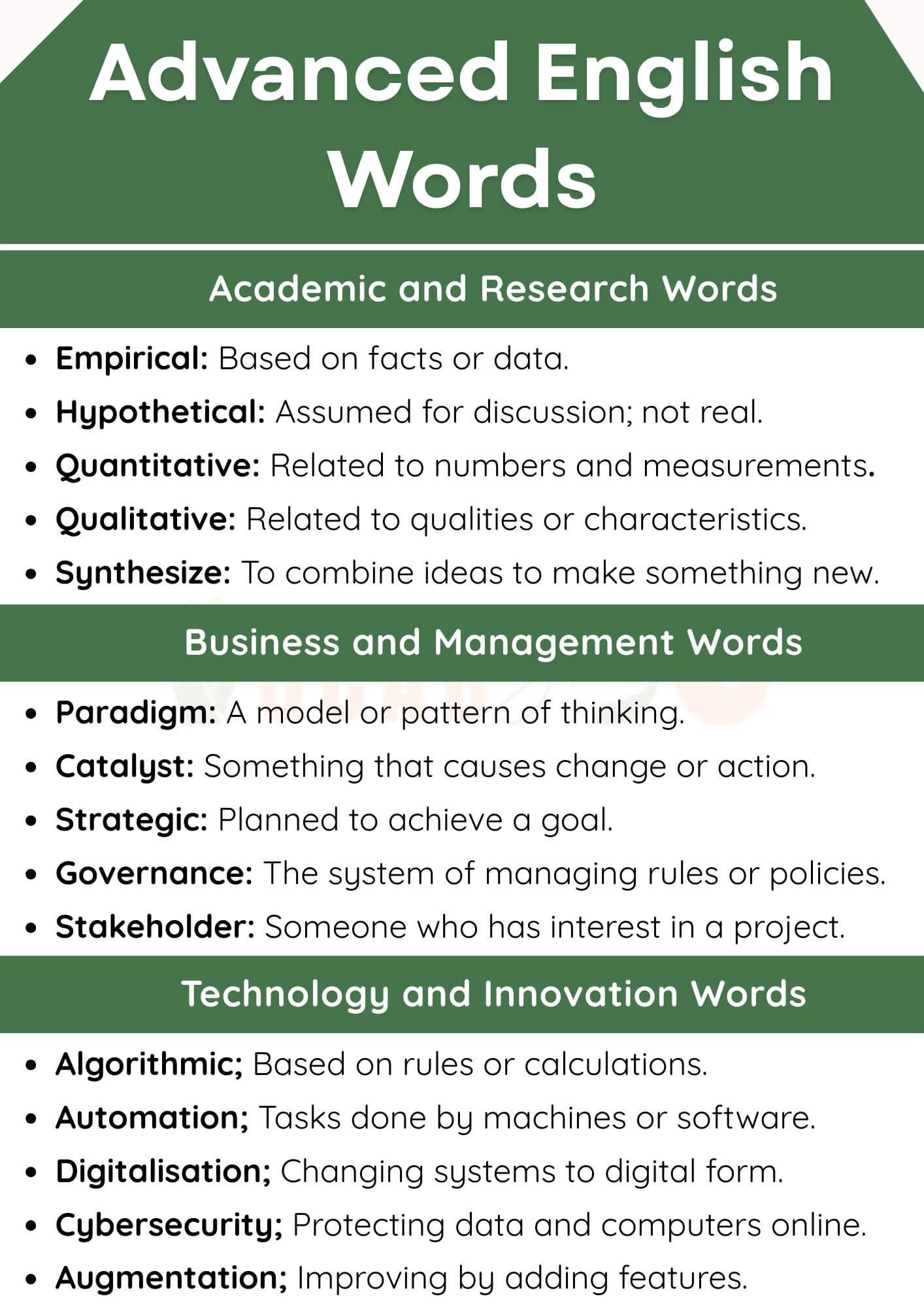
Academic and Research Words
These words are mostly used in studies, reports, and research.
- Empirical: Based on facts or data.
- Hypothetical: Assumed for discussion; not real.
- Quantitative: Related to numbers and measurements.
- Qualitative: Related to qualities or characteristics.
- Synthesize: To combine ideas to make something new.
- Criticality: Importance of a decision or factor.
- Evaluation: Careful examination of something.
- Validation: Confirming that something is correct.
- Competency: The ability or skill to do a task.
- Analytical: Ability to examine and understand information.
Business and Management Words
Used in companies, management, and planning.
- Paradigm: A model or pattern of thinking.
- Catalyst: Something that causes change or action.
- Strategic: Planned to achieve a goal.
- Governance: The system of managing rules or policies.
- Stakeholder: Someone who has interest in a project.
- Leverage: To use resources or influence effectively.
- Alignment: Agreement or coordination of actions.
- Implementation: The act of putting a plan into action.
- Monetisation: Turning something into money or profit.
- Accountability: Being responsible for actions.
Technology and Innovation Words
Common in IT, digital, and modern business contexts.
- Algorithmic: Related to a set of rules or calculations.
- Automation: Machines or software doing tasks automatically.
- Digitalisation: Changing to a digital form or system.
- Cybersecurity: Protecting computers and data from attacks.
- Augmentation: Improving something by adding extra features.
- Predictive: Used to foresee results or trends.
- Interoperability: Ability of systems to work together.
- Data-driven: Based on information and statistics.
- Forward-thinking: Planning for the future smartly.
- Future-proof: Designed to remain useful in the future.
Communication and Writing Words
Useful for speaking, writing, and expressing ideas clearly.
- Discourse: Written or spoken communication.
- Articulate: Able to express ideas clearly.
- Ambiguous: Having more than one meaning.
- Coherent: Clear and logical to understand.
- Nuanced: Having small and subtle differences.
- Scrutiny: Careful examination or study.
- Ethical: Following moral rules or principles.
- Consensus: General agreement among a group.
- Rationalisation: Making something seem reasonable.
- Evidence-based: Supported by facts or data.
Problem-Solving and Decision Making Words
Helps in making choices and solving issues.
- Pragmatic: Dealing with realistic solutions.
- Feasible: Possible to do easily or successfully.
- Resilient: Able to recover quickly from problems.
- Viability: Ability to work successfully.
- Mitigate: To make a problem less serious.
- Contingency: A possible future event.
- Proactive: Taking action before problems occur.
- Decentralised: Spread out, not controlled by one place.
- Risk-averse: Avoiding dangerous or risky situations.
- Outcome-oriented: Focused on final results.
Everyday Advanced Words
These are commonly used in daily life in formal speech or writing.
- Ubiquitous: Found everywhere.
- Innovative: Using new ideas or methods.
- Robust: Strong and able to handle pressure.
- Prevalent: Widespread or common.
- Salient: Most important or noticeable.
- Adaptive: Able to adjust to new situations.
- Holistic: Considering the whole system.
- Multi-dimensional: Having many aspects or sides.
- Competitive: Strong in comparison with others.
- Cutting-edge: Very modern or advanced.
Other Useful Advanced Words
These words are helpful in multiple contexts.
- Transparency: Openness in actions or decisions.
- Incentivise: Give reasons or motives to act.
- Redundant: Not needed anymore.
- Scalable: Able to grow or expand easily.
- Benchmark: A standard for comparison.
- Credibility: Being trusted or believable.
- Volatility: Likely to change suddenly.
- Speculative: Based on guesswork, not fact.
- Time-sensitive: Requires immediate attention.
- Mission-critical: Extremely important for success.
100 Advanced English Words
Advanced English Words with PDF
Conclusion
Mastering advanced English words can improve your communication, reading, and writing skills. These words are widely used in business, technology, academics, and daily conversation. By learning them with simple examples and explanations, you can speak and write with confidence. Use this list as a daily practice guide and focus on understanding and using words naturally.
FAQs about Advanced English Words
What are advanced English words?
Advanced English words are words used in formal, academic, or professional contexts that are more complex than everyday vocabulary. They help you express ideas clearly and professionally, like ubiquitous (found everywhere) or pragmatic (practical and realistic).
How can I use advanced English words in sentences?
You can use them by replacing simple words with more precise ones. For example: “She is resilient” instead of “She recovers quickly,” or “The company made a strategic decision” instead of “The company planned carefully.”
What are some examples of powerful advanced words?
Powerful advanced words include: catalyst, innovative, robust, salient, and cutting-edge. Example sentence: “Her speech acted as a catalyst for positive change.”
What are tricky advanced English words?
Tricky words are those that are hard to spell, understand, or use correctly, such as nuanced, ambiguous, and interdisciplinary. Example: “The novel has a nuanced meaning that requires careful reading.”
Why should I learn advanced English words with sentences?
Learning advanced words with sentences helps you understand context, improve communication, and remember the words better. For example, knowing adaptive (able to adjust) is easier if you see it in a sentence: “Cats are very adaptive to new environments.”
Can you give examples of advanced English words with meanings?
Yes. Here are a few:
Ubiquitous: found everywhere – “Smartphones are ubiquitous today.”
Pragmatic: practical – “She took a pragmatic approach to the problem.”
Resilient: able to recover – “Children are very resilient after challenges.”
Read More