

Understanding how actions happen over time is a key part of English Grammar, and studying the Verb Tenses Chart: Uses, Formulas, and Examples helps you use English correctly. In this blog post, you will see each tense with its formula and examples, making it easier to learn and remember how to apply them. Knowing verb tenses improves speaking, reading, and writing skills, and allows you to describe events, tell stories, and follow instructions accurately. Mastering verb tenses makes your English more confident and precise.
Verb Tenses Definition and Examples
A verb tense shows the time of an action or state. It answers questions like:
- Did it happen before now?
- Is it happening now?
- Will it happen later?
English has three main time frames:
- Past
- Present
- Future
Each time frame has four forms:
- Simple
- Continuous (Progressive)
- Perfect
- Perfect Continuous
Together, these make the 12 verb tenses.
Types of the 12 Verb Tenses
Here is the full list:
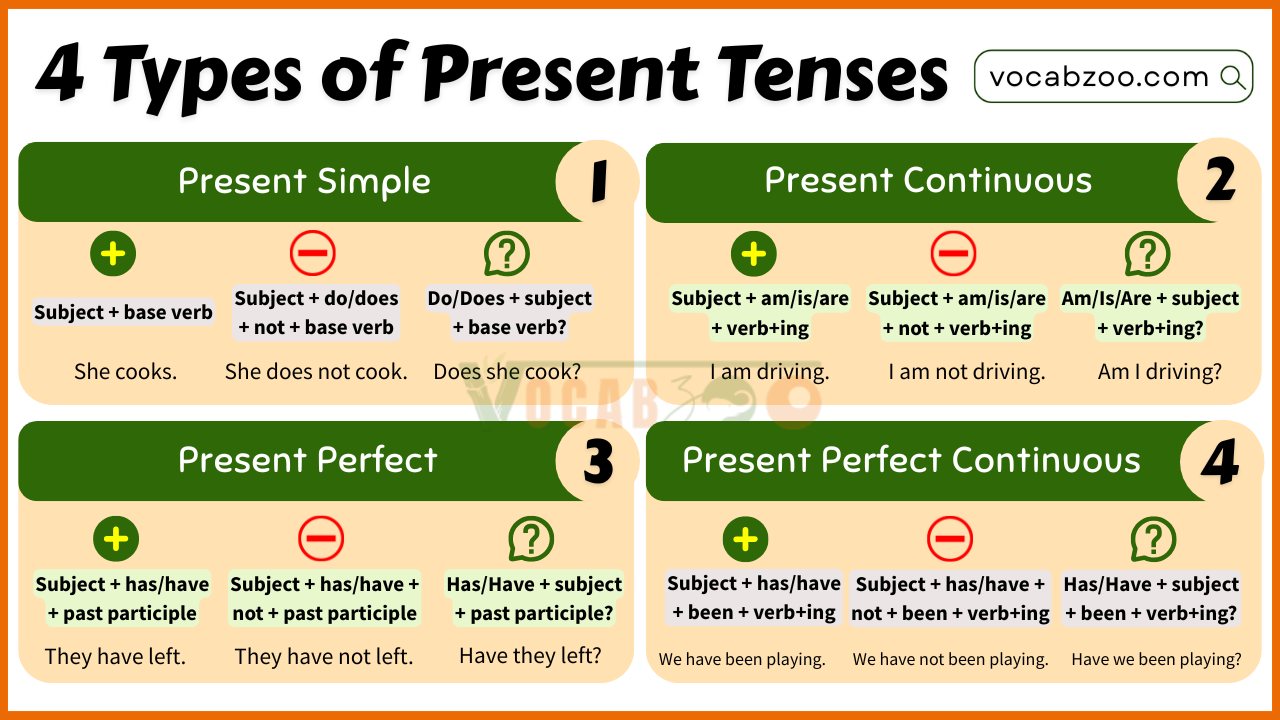
A. Present Tenses
Present Simple – habits, facts
Example: I work in a shop.
Present Continuous – actions happening now
Example: I am working now.
Present Perfect – past action with result now
Example: I have finished my work.
Present Perfect Continuous – action started in past and still going
Example: I have been working for two hours.
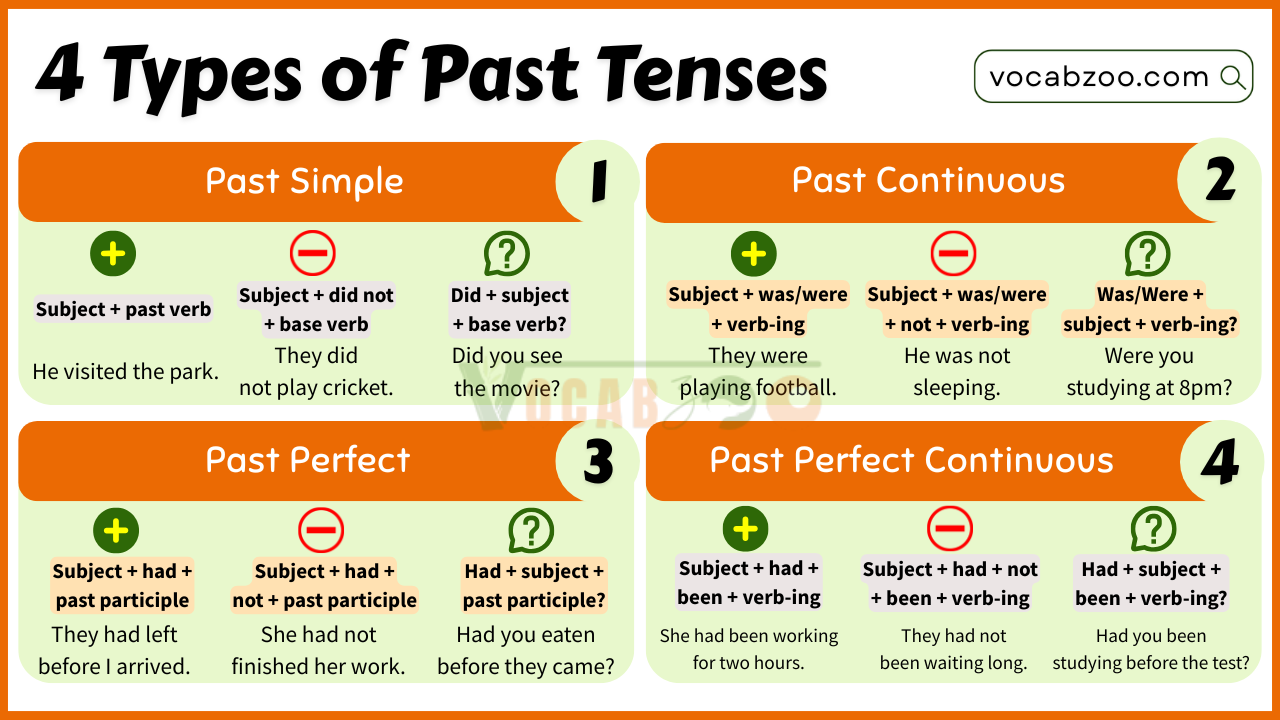
B. Past Tenses
Past Simple – finished action in the past
Example: I worked yesterday.
Past Continuous – action in progress in the past
Example: I was working at 8 pm.
Past Perfect – earlier past action
Example: I had worked before dinner.
Past Perfect Continuous – long action before another past action
Example: I had been working all day.
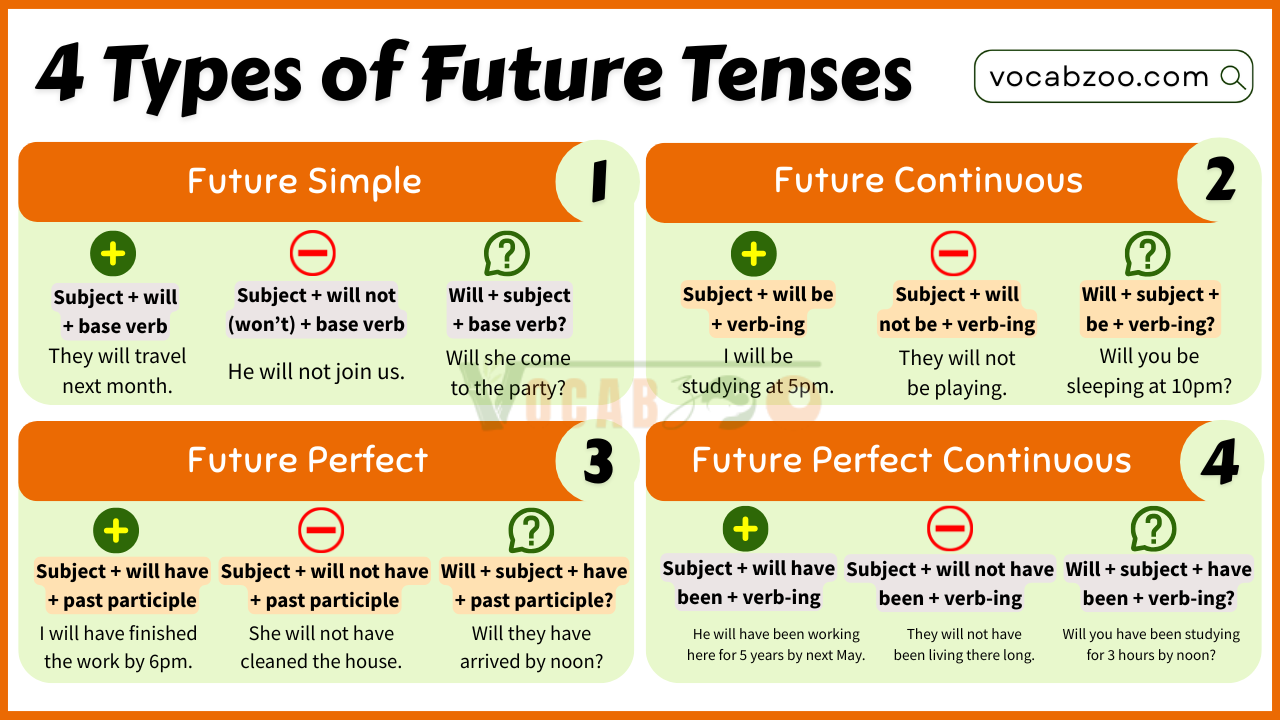
C. Future Tenses
Future Simple – decisions, promises
Example: I will work tomorrow.
Future Continuous – action in progress in the future
Example: I will be working at 9 am.
Future Perfect – action finished before a future time
Example: I will have worked by noon.
Future Perfect Continuous – long action until a future time
Example: I will have been working for five hours.
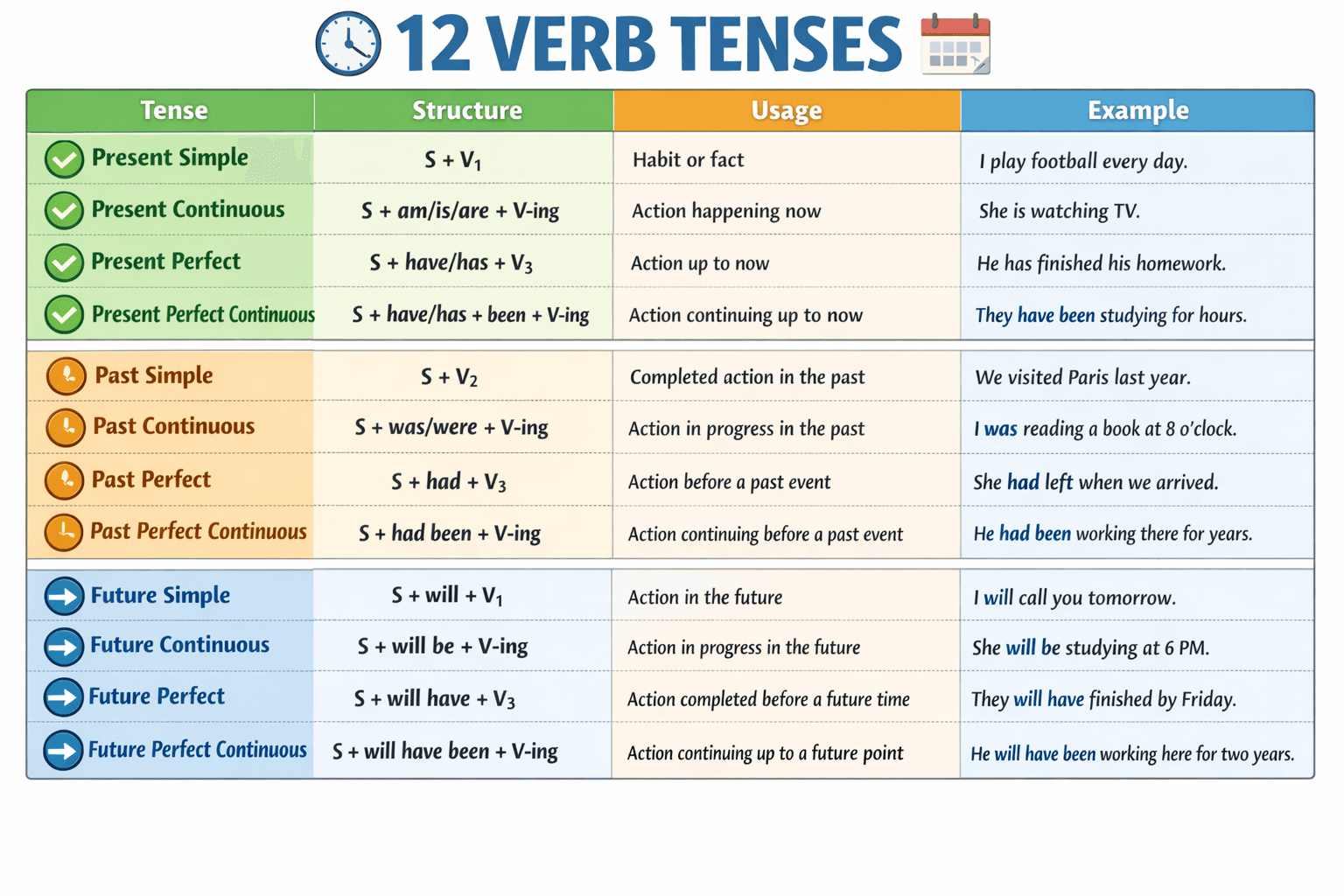
Tenses Chart
Rules and Usage of Verb Tenses
Let’s learn how to form each tense with their examples in sentences.
Present Simple
Form: Subject + base verb / verb + s (for he/she/it)
I play.
She plays.
Use:
Daily habits
General truths
Timetables
Present Continuous
Form: am / is / are + verb + ing
I am reading.
They are watching TV.
Use:
Action happening now
Temporary situations
Present Perfect
Form: has / have + past participle
I have eaten.
She has gone.
Use:
Past action with result now
Life experiences
Present Perfect Continuous
Form: has / have been + verb + ing
I have been studying.
Use:
Action started in past and still continuing
Past Simple
Form: verb + ed / irregular verb
I walked.
I went.
Use:
Finished action in the past
Past Continuous
Form: was / were + verb + ing
I was reading.
Use:
Action in progress in the past
Past Perfect
Form: had + past participle
I had eaten.
Use:
One action before another in the past
Past Perfect Continuous
Form: had been + verb + ing
I had been working.
Use:
Long action before another past action
Future Simple
Form: will + base verb
- I will call you.
Use:
- Decisions made now
- Promises
Future Continuous
Form: will be + verb + ing
- I will be travelling.
Use:
- Action in progress in the future
Future Perfect
Form: will have + past participle
- I will have finished.
Use:
- Action finished before a future time
Future Perfect Continuous
Form: will have been + verb + ing
- I will have been studying.
Use:
- Long action until a future point
Affirmative, Negative, and Question Examples
Present Simple
✔ I like coffee.
✘ I do not like tea.
? Do you like coffee?
Present Continuous
✔ She is cooking.
✘ She is not cooking.
? Is she cooking?
Present Perfect
✔ They have finished.
✘ They have not finished.
? Have they finished?
Past Simple
✔ He called me.
✘ He did not call me.
? Did he call you?
Future Simple
✔ I will help you.
✘ I will not help today.
? Will you help me?
Common Mistakes
Using Present Simple for “now”
Wrong: I eat now.
Right: I am eating now.
Forgetting has / have in perfect tense
Wrong: She finished her work.
Right: She has finished her work.
Mixing past and present
Wrong: Yesterday I go to school.
Right: Yesterday I went to school.
Using will for plans already decided
Wrong: I will go to London next week.
Right: I am going to London next week.
Comparisons of Verb Tenses
| Tense | Use | Example |
|---|---|---|
| Present Simple | Habit | I play football. |
| Present Continuous | Action now | I am playing football. |
| Past Simple | Finished past | I played yesterday. |
| Present Perfect | Result now | I have played today. |
12 Tenses Chart
| Tense | Structure | Usage | Example Sentence |
|---|---|---|---|
| Present Simple | Subject + base verb (+ s/es for he/she/it) | Habits, routines, facts, general truths | I play tennis. |
| Present Continuous | Subject + am / is / are + verb-ing | Action happening now or temporary action | She is reading. |
| Present Perfect | Subject + have / has + past participle | Past action with a result in the present | They have eaten. |
| Present Perfect Continuous | Subject + have / has been + verb-ing | Action started in the past and still continuing | I have been working. |
| Past Simple | Subject + past verb (-ed / irregular form) | Completed action in the past | He watched TV. |
| Past Continuous | Subject + was / were + verb-ing | Action in progress at a specific time in the past | We were playing. |
| Past Perfect | Subject + had + past participle | One action happened before another in the past | She had left. |
| Past Perfect Continuous | Subject + had been + verb-ing | How long an action continued before another past action | They had been talking. |
| Future Simple | Subject + will + base verb | Decisions, promises, predictions | I will call you. |
| Future Continuous | Subject + will be + verb-ing | Action in progress at a future time | He will be working. |
| Future Perfect | Subject + will have + past participle | Action finished before a future time | We will have arrived. |
| Future Perfect Continuous | Subject + will have been + verb-ing | How long an action continues up to a future point | She will have been waiting. |
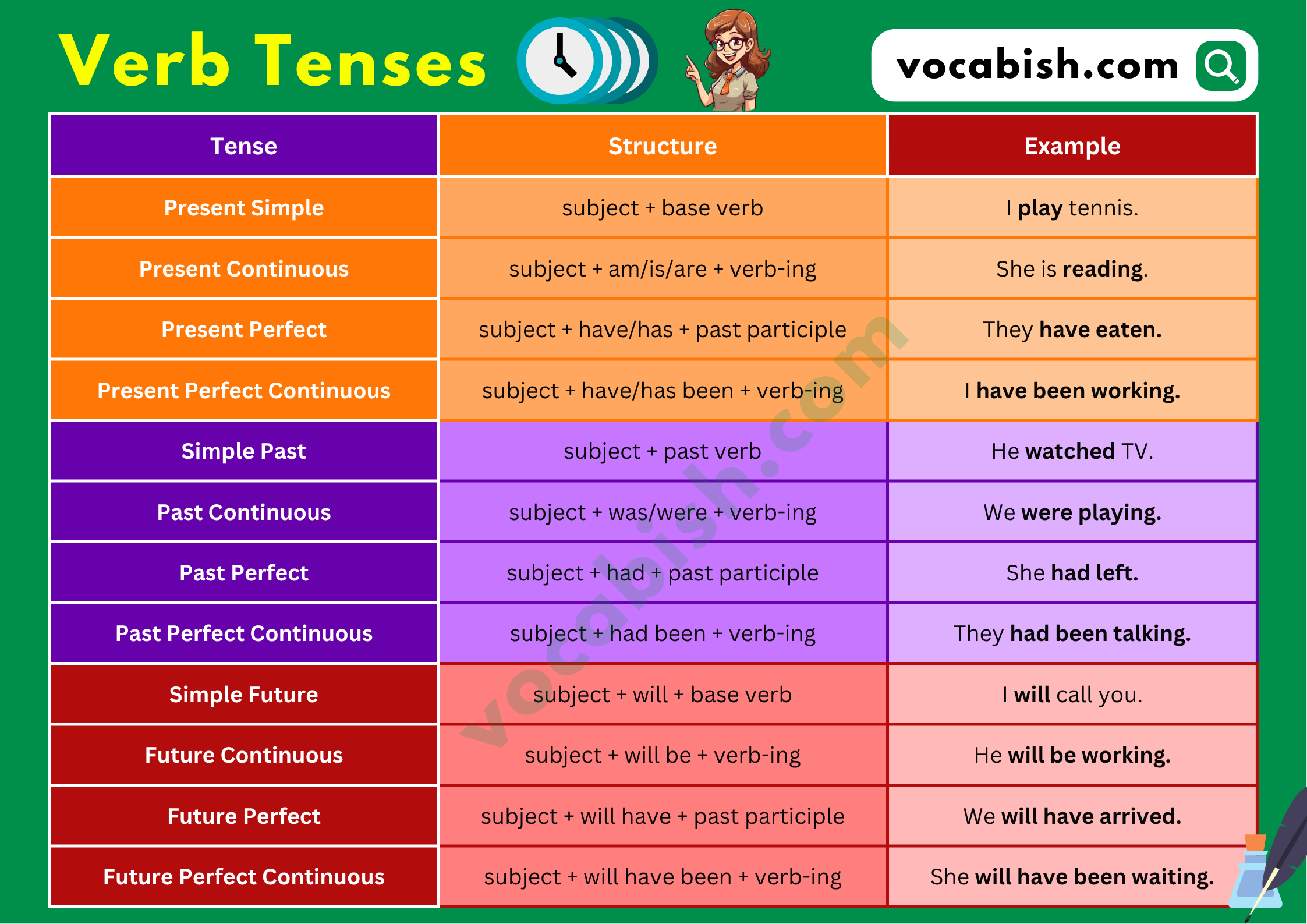
12 Verb Tenses Chart
Tips for Learners
- Learn one tense at a time.
- Practise with daily sentences.
- Listen to English podcasts and notice tenses.
- Write short stories using different tenses.
- Check verb forms in a dictionary.
- Speak with others and correct your mistakes.
Conclusion
The 12 verb tenses help you show time clearly in English. Each tense has a special job. When you understand how and when to use them, your speaking and writing become strong and confident. Practise daily with real-life examples. Use English in your own life. The more you use tenses, the easier they become.
Read More

This verb tenses chart is such a valuable resource for learning English! It makes understanding the different tenses so much clearer and easier to remember. Thank you for sharing this well-organized and practical guide!