
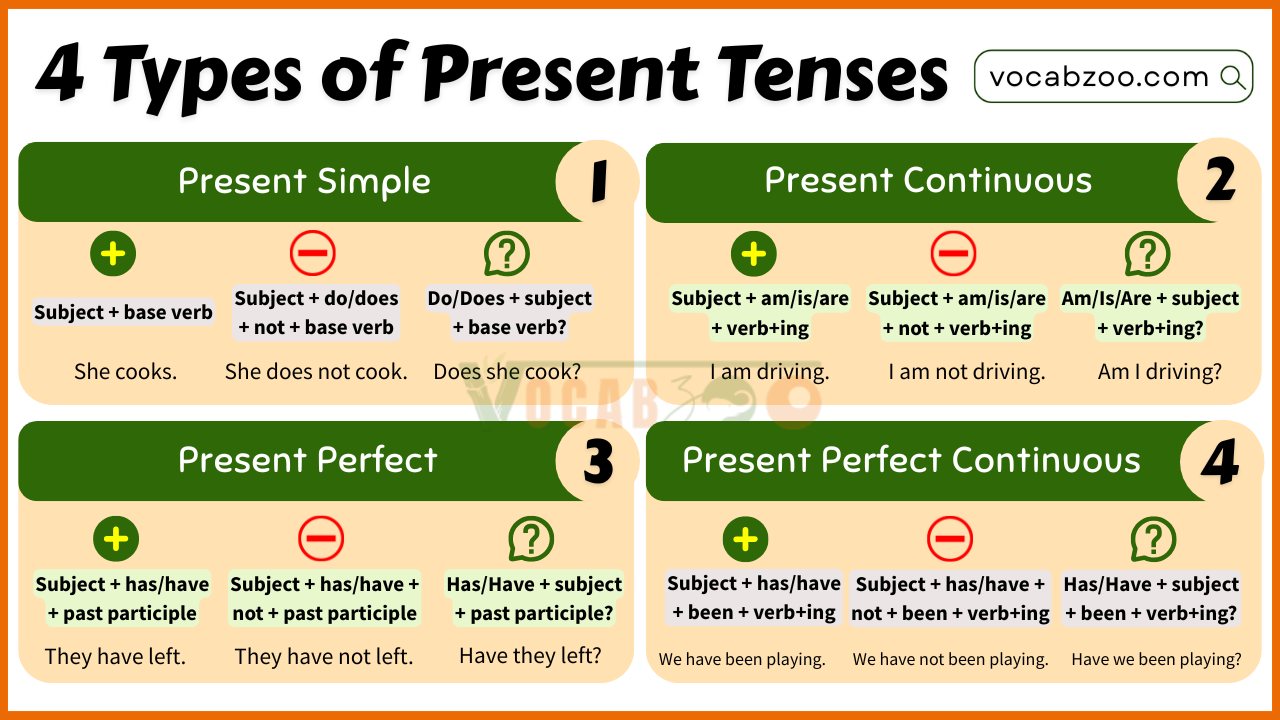

Understanding present tenses is key to speaking and writing English correctly. In this blog post, we will explain all the present tense forms, including simple, continuous, and perfect tenses, in a way that helps you understand when and how to use them. Learning present tenses improves your reading, writing, listening, and speaking skills, making it easier to talk about daily routines, actions happening now, and experiences. With examples and explanations, you can master present tenses and use them confidently in real-life English.
Types of Present Tenses
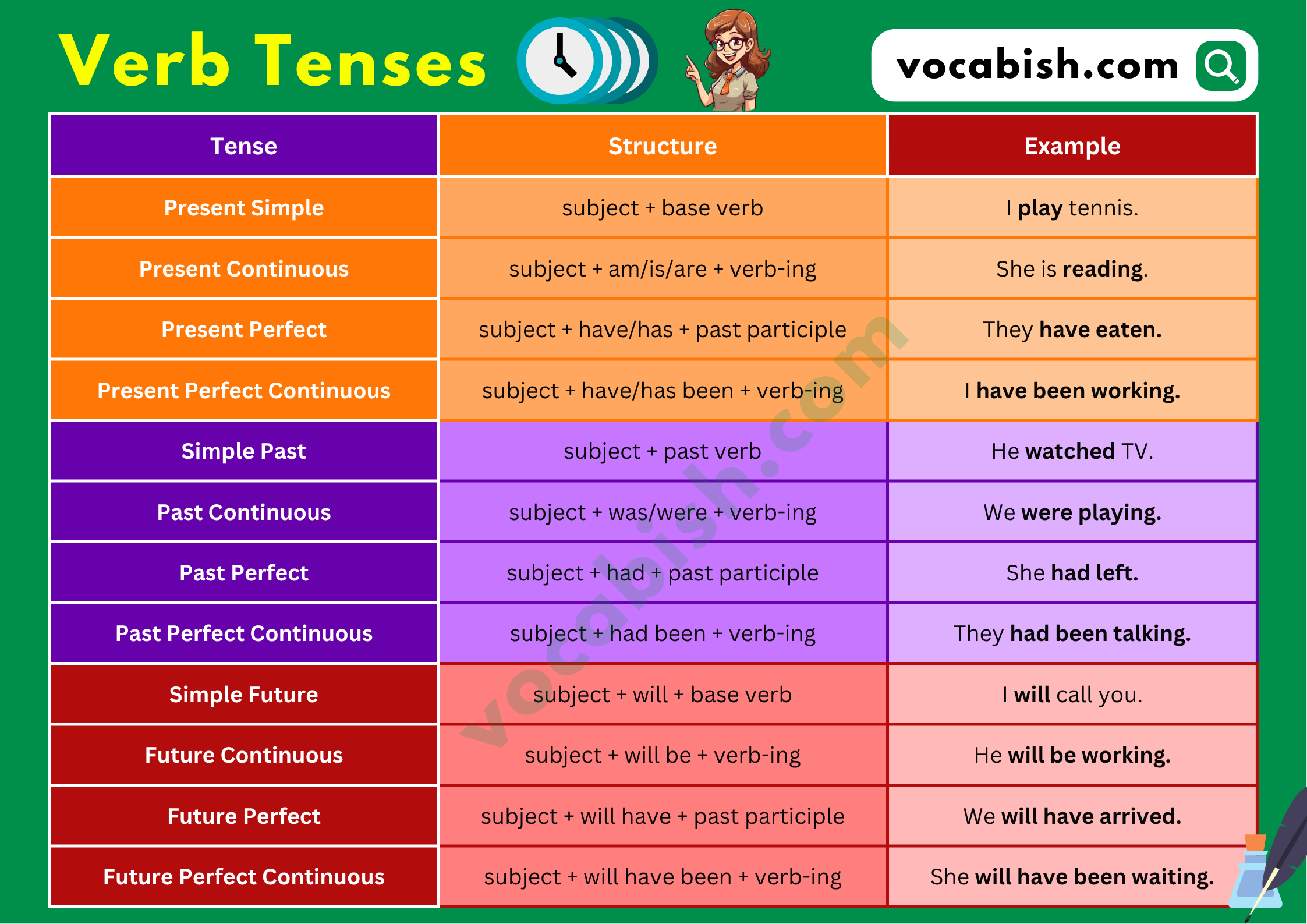
- Present Simple
- Present Continuous
- Present Perfect
- Present Perfect Continuous
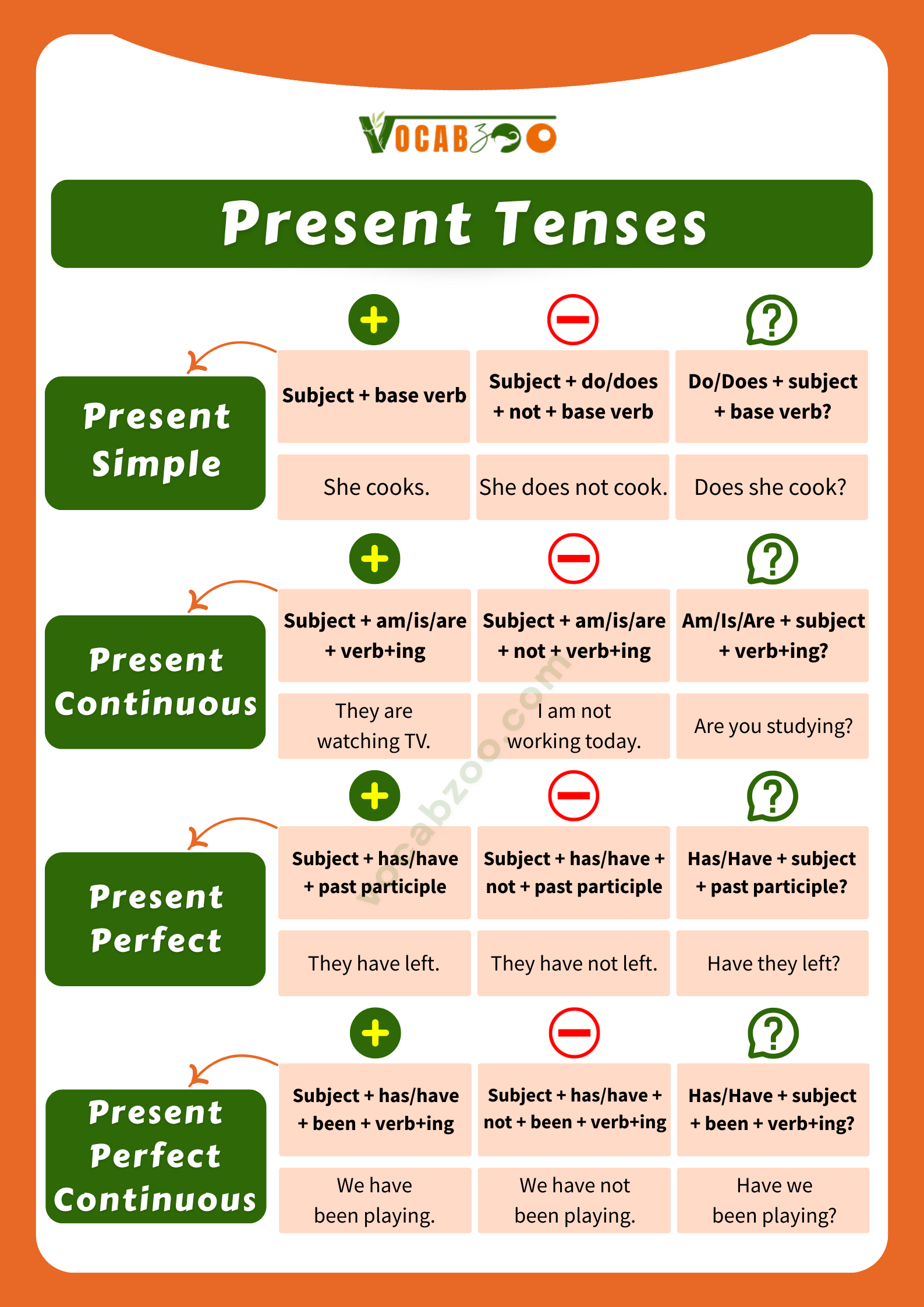
4 Types of Present Tenses
1. Present Simple Tense
The present simple tense uses the base form of the verb (with s/es in third-person singular).
Use of Present Simple Tense
- Habits or routines (I go to school every day.)
- Facts or truths (The sun rises in the east.)
- Timetables or schedules (The train leaves at 6 p.m.)
Structure of Present Simple Tense
| Positive | Negative | Question |
|---|---|---|
| Subject + base verb | Subject + do/does + not + base verb | Do/Does + subject + base verb? |
Examples of Present Simple Tense
- Positive: I eat breakfast.
- Negative: She does not play football.
- Question: Do you like apples?
2. Present Continuous Tense
A tense made with “am/is/are” plus the “-ing” form of the verb.
Use of Present Continuous Tense
- Actions happening right now (She is writing a letter.)
- Temporary actions (I am staying at my uncle’s house.)
- Changing situations (The weather is getting warmer.)
Structure of Present Continuous Tense
| Positive | Negative | Question |
|---|---|---|
| Subject + am/is/are + verb+ing | Subject + am/is/are + not + verb+ing | Am/Is/Are + subject + verb+ing? |
Examples of Present Continuous Tense
- Positive: They are watching TV.
- Negative: I am not working today.
- Question: Are you studying?
3. Present Perfect Tense
A tense made with “has/have” plus the past participle of the verb.
Use of Present Perfect Tense
- Action completed in the past with a result now (I have finished my homework.)
- Experiences (She has visited Paris.)
- Recently completed actions (They have just arrived.)
Structure of Present Perfect Tense
| Positive | Negative | Question |
|---|---|---|
| Subject + has/have + past participle | Subject + has/have + not + past participle | Has/Have + subject + past participle? |
Examples of Present Perfect Tense
- Positive: She has finished her homework.
- Negative: We have not seen that movie.
- Question: Have you eaten lunch?
4. Present Perfect Continuous Tense
A tense made with “has/have been” plus the “-ing” form of the verb.
Use of Present Perfect Continuous
- Action started in the past and still happening (She has been working here for 5 years.)
- Action that just stopped, but shows evidence (He is tired because he has been running.)
Structure of Present Perfect Continuous
| Positive | Negative | Question |
|---|---|---|
| Subject + has/have + been + verb+ing | Subject + has/have + not + been + verb+ing | Has/Have + subject + been + verb+ing? |
Examples of Present Perfect Continuous
- Positive: He has been reading for an hour.
- Negative: They have not been sleeping well.
- Question: Have you been working today?
Easy Rules to Remember
- Use present simple for habits.
- Use present continuous for now.
- Use present perfect for past action with present result.
- Use present perfect continuous for past to now action.
Practice Sentences
| Tense | Positive | Negative | Question |
|---|---|---|---|
| Present Simple | She cooks. | She does not cook. | Does she cook? |
| Present Continuous | I am driving. | I am not driving. | Am I driving? |
| Present Perfect | They have left. | They have not left. | Have they left? |
| Present Perfect Continuous | We have been playing. | We have not been playing. | Have we been playing? |
Present tenses help us talk about now, habits, and connected past actions. Learn their simple rules, remember the sentence patterns, and you will use them easily in English.
FAQs about Present Tenses
What is Present Tense?
The present tense describes an action happening now or something that happens regularly. Example: I read books every day.
What is Present Perfect Tense?
The present perfect tense shows an action that happened in the past but has a connection to the present. Example: I have finished my homework.
What is Simple Present Tense?
The simple present tense expresses habits, facts, or general truths. Example: She works in an office.
What is Present Continuous Tense?
The present continuous tense describes an action that is happening right now or around this time. Example: They are watching TV.
What is Present Perfect Continuous Tense?
The present perfect continuous tense shows an action that started in the past and is still continuing now. Example: He has been studying since morning.
Read More

This explanation of present tenses is so clear and well-organized! It really helps to understand the differences between present simple, present continuous, and present perfect. Thank you for making English grammar easier to learn with such a detailed guide!