

Consistency is key to improving English, and even a short daily routine can make a big difference. In this article, you will learn a 30 Minute Daily English Learning Plan suitable for all levels, designed to help you practice speaking, reading, writing, and listening every day. Following this plan regularly strengthens your vocabulary, grammar, and overall language skills. When you dedicate just 30 minutes daily, your confidence grows, your communication becomes smoother, and your English improves steadily. Keep reading to learn a practical routine that will help you master English step by step.
Why a 30-Minute Daily English Plan Works
Short daily practice works better than long study sessions once or twice a week. A 30-minute plan is easy to fit into daily life and helps learners stay consistent.
Key benefits:
- Easy to follow, even on busy days
- Reduces stress and learning pressure
- Helps build habits naturally
- Improves all English skills step by step
Like good interior design, balance is important. This plan gives equal attention to listening, speaking, reading, writing, grammar, and vocabulary—without overload.
Simple Structure of the 30-Minute Plan
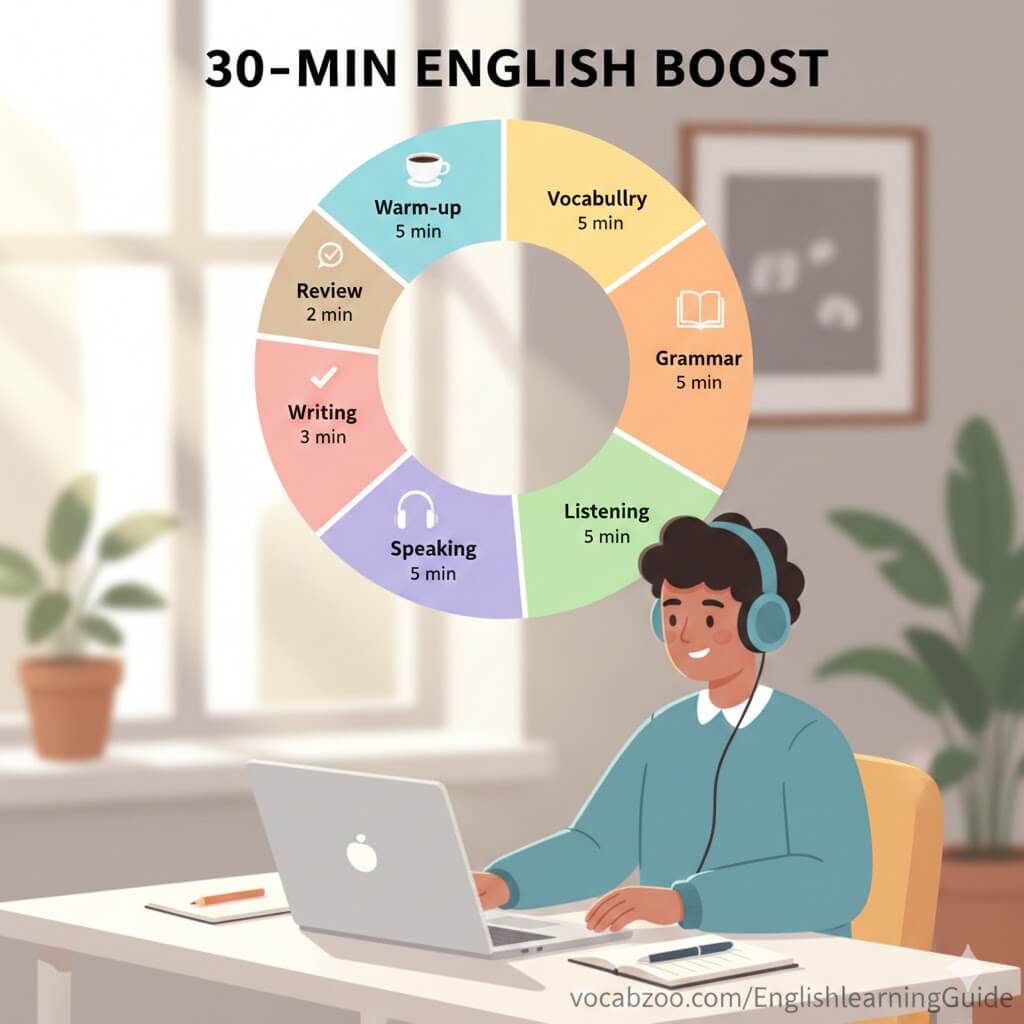
The 30 minutes are divided into small sections. Each section has a clear purpose, just like rooms in a well-designed home.
Daily Structure Overview
Here’s how the 30 minutes are divided:
| Time | Activity |
|---|---|
| 5 minutes | Warm-up |
| 5 minutes | Vocabulary |
| 5 minutes | Grammar |
| 5 minutes | Listening |
| 5 minutes | Speaking |
| 3–4 minutes | Writing |
| 2–3 minutes | Review |
This structure ensures balance. Many learners make the mistake of focusing only on grammar or vocabulary. But English is a living language. You must use it, not just study it.
Another advantage of this structure is rotation without burnout. You touch every skill briefly, which keeps your brain fresh. It’s like a workout routine—you train different muscles instead of exhausting one.
Warm-Up (5 Minutes)
Warm-ups are often ignored, but they’re crucial. Imagine running without stretching—you might get injured. Learning English without warming up leads to mental resistance and slow thinking.
A warm-up prepares your brain to think in English. It gently switches your mind from your native language into English mode.
Best Warm-Up Activities
- Read a short paragraph aloud
- Review yesterday’s vocabulary
- Answer 2–3 simple questions in English
- Describe what you see around you
- Listen to a short English clip without pressure
Level-Based Examples
- Beginner: Read simple sentences and repeat them slowly
- Intermediate: Summarize yesterday’s lesson in 2–3 sentences
- Advanced: Speak freely about a random topic for one minute
This isn’t about perfection. It’s about activation. Even if you make mistakes, you’re waking up the English part of your brain—and that’s powerful.

Vocabulary Practice (5 Minutes)
Vocabulary is the building material of language. But learning random word lists is one of the biggest mistakes learners make. The goal isn’t to learn more words—it’s to learn useful words deeply.
Five minutes a day is enough if you focus on context.
How Many Words?
- 3–5 new words per day is ideal
- Focus on high-frequency words and phrases
Smart Techniques
- Learn words in sentences, not isolation
- Say the word out loud
- Create a personal example
- Notice collocations (words that go together)
By Level
- Beginner: Everyday nouns, verbs, and simple adjectives
- Intermediate: Phrasal verbs, idioms, and connectors
- Advanced: Nuanced synonyms, tone-based expressions, collocations
Instead of memorizing, experience the word. When a word connects to your life, it sticks naturally.

Grammar Practice (5 Minutes)
Grammar doesn’t have to be scary. The problem isn’t grammar itself—it’s how it’s taught. Rules without context feel meaningless and overwhelming.
In this plan, grammar is always connected to real usage.
How to Practice Grammar
- Study one small concept at a time
- See examples in real sentences
- Use the structure in your own sentence
By Level
- Beginner: Present tense, basic sentence structure
- Intermediate: Past/future forms, conditionals
- Advanced: Nuance, emphasis, complex sentence patterns
Think of grammar as traffic rules. They don’t stop you from driving—they help you move smoothly.

Listening Practice (5 Minutes)
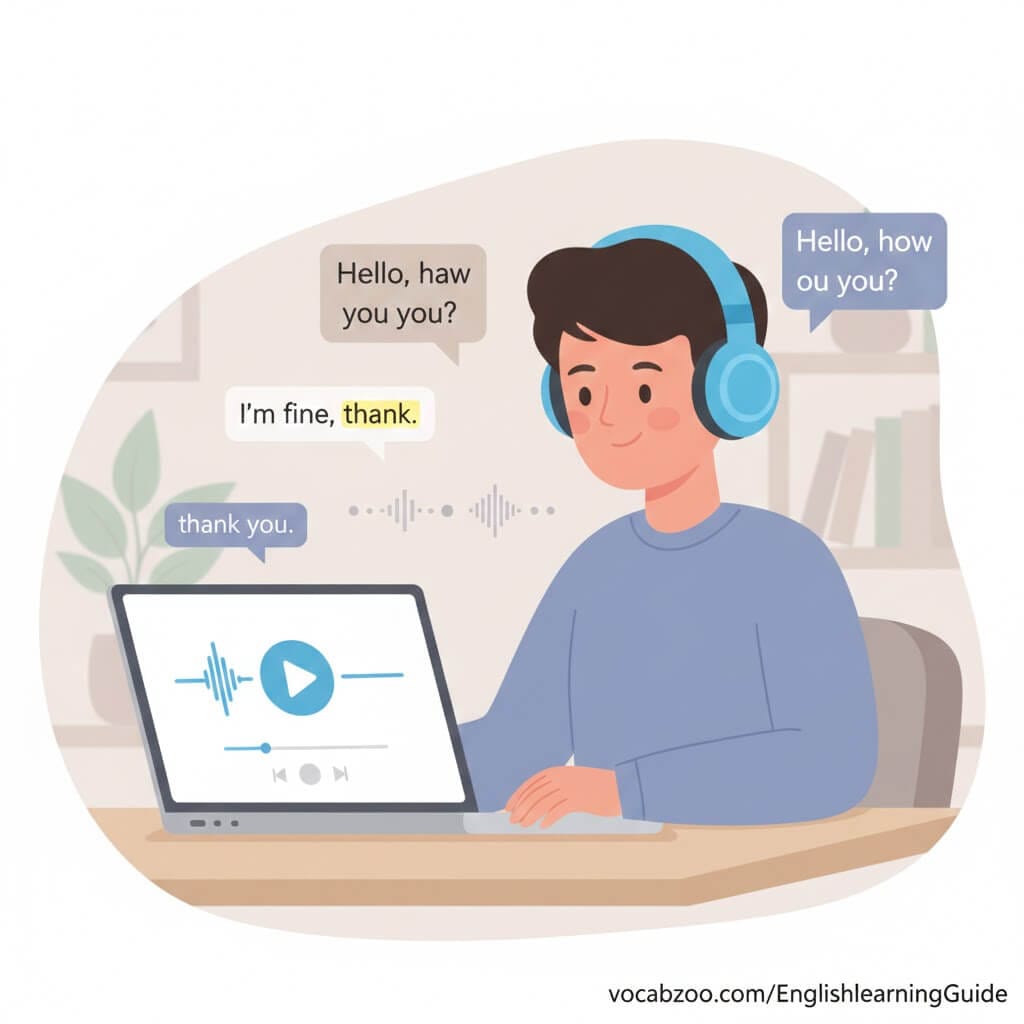
Listening helps you understand real English and improves pronunciation.
What to Listen To
- Beginner: Slow dialogues, simple videos
- Intermediate: YouTube lessons, short podcasts
- Advanced: Interviews, audiobooks, news
Active Listening
- Listen for keywords
- Notice pronunciation and rhythm
- Don’t translate—understand the idea
Even five minutes daily trains your ear to recognize patterns, accents, and natural flow.
Speaking Practice (5 Minutes)
Speaking is the most important skill. Many learners avoid it, but daily small practice makes a big difference.
Solo Speaking Ideas
- Talk about your day
- Describe a picture or object
- Repeat sentences from listening practice
- Answer simple questions aloud
By levels:
- Beginner: Simple sentences, repetition
- Intermediate: Opinions, short explanations
- Advanced: Storytelling, arguments, reflections
Fluency isn’t about speed. It’s about clarity and confidence.

Writing Practice (3–4 Minutes)
Writing helps organize your thoughts. Short writing is powerful because it’s sustainable.
Daily Micro-Writing
- 3–5 sentences
- One clear idea
- No overthinking
Prompts
- What did you learn today?
- What do you feel right now?
- Describe something simple
Writing turns passive knowledge into active control.

Review and Reflection (2–3 Minutes)
This is where learning becomes permanent.
Simple Review Methods
- Recall today’s words
- Repeat one sentence aloud
- Ask: What did I improve today?
Reflection builds awareness—and awareness accelerates progress.

Weekly Focus for Better Results
To avoid boredom, change focus slightly each day.
Example weekly focus:
- Day 1: Vocabulary
- Day 2: Grammar
- Day 3: Listening
- Day 4: Speaking
- Day 5: Writing
- Day 6–7: Light review and fun content
This keeps learning fresh and interesting.
Monthly Progress Tracking
Track:
- Speaking confidence
- Listening comprehension
- Vocabulary usage
Adjust difficulty, not duration.
How to Stay Motivated Long-Term
Motivation fades. Habits last.
- Study at the same time daily
- Reward consistency
- Surround yourself with English
English becomes part of your life, not a task.
Tips to Stay Consistent
- Study at the same time daily
- Keep materials simple
- Do not aim for perfection
- Focus on progress, not speed
Consistency is more important than long study hours.
Adapting the Plan for Busy Days
Even 10 minutes counts:
- Listen while commuting
- Speak while walking
- Write one sentence
Consistency > perfection.
Tools and Resources to Support the Plan
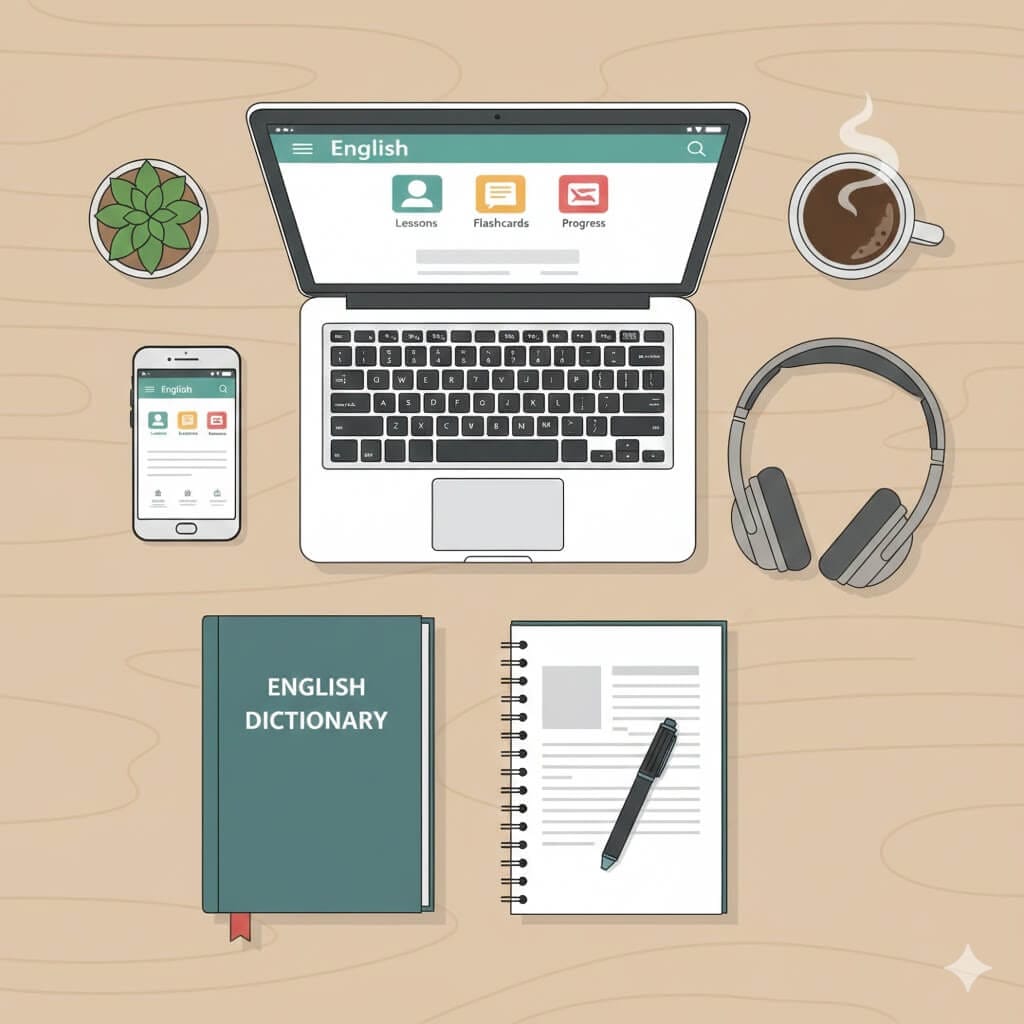
- Dictionaries with examples
- Podcasts and YouTube
- Voice recording apps
- Simple notebooks
Choose tools that feel easy, not impressive.
Common Mistakes to Avoid
- Studying too many topics at once
- Ignoring speaking practice
- Skipping days often
- Trying to be perfect
Simple, regular practice always works better.
Conclusion
A 30-minute daily English learning plan is simple, effective, and realistic for all levels. With the right structure, clear focus, and easy steps, learners can improve English without stress. Just like good home design, when learning is organized and balanced, it feels comfortable and motivating. Practice daily, keep it simple, and English improvement will follow naturally.
This plan is easy to understand, easy to follow, and designed to help learners stay on the page—and stay committed to learning.
Frequently Asked Questions
What is a 30-Minute Daily English Learning Plan for All Levels?
A 30-Minute Daily English Learning Plan for All Levels is a short, structured study routine that covers speaking, listening, reading, writing, vocabulary, and grammar in just half an hour. It is designed to help beginners, intermediate, and advanced learners improve English consistently without feeling overwhelmed.
Is a 30-minute daily English learning plan enough to improve English?
Yes, a 30-minute daily English learning plan is enough when practiced consistently. Daily short sessions help the brain remember better, build habits, and improve fluency over time. Regular practice is more effective than long, irregular study sessions for most English learners.
Who can follow a 30-Minute Daily English Learning Plan for All Levels?
This plan is suitable for beginners, intermediate learners, and advanced users. The structure stays the same, but the difficulty of materials changes. Learners can adjust vocabulary, grammar, and listening content based on their current English level and learning goals.
What skills are included in a 30-minute daily English learning plan?
A 30-minute daily English learning plan usually includes vocabulary, grammar, listening, speaking, reading, and short writing practice. This balanced approach helps learners improve overall English communication skills instead of focusing on only one area.
How should beginners use a 30-Minute Daily English Learning Plan for All Levels?
Beginners should focus on simple words, basic grammar, short listening clips, and speaking in easy sentences. The goal is understanding and confidence, not perfection. Using clear examples and daily repetition helps beginners build a strong English foundation.
Can intermediate and advanced learners benefit from a 30-minute English study plan?
Yes, intermediate and advanced learners benefit by refining fluency, pronunciation, and accuracy. They can use the same 30-minute English learning plan with more complex vocabulary, natural listening materials, and longer speaking or writing tasks.
Why is consistency important in a 30-minute daily English learning plan?
Consistency helps the brain absorb and retain language naturally. Studying English for 30 minutes every day creates a routine, improves memory, and leads to steady progress. Skipping days often slows learning more than studying for a shorter time daily.
How soon can learners see results from a 30-Minute Daily English Learning Plan for All Levels?
Most learners notice improvement within four to eight weeks. Understanding becomes clearer, speaking feels easier, and confidence grows. Results depend on consistency, focus, and using the plan correctly rather than studying longer hours.
Read More